Pressure Washer Types: Complete Guide for Acreage Owners
A guide to pressure washer types for acreage owners: cordless handheld, corded electric, and gas models compared for property maintenance.

On this page
Top picks at a glance
As an Amazon Associate I earn from qualifying purchases.
- 1
 JANZ 24 in Stainless Steel Pressure Washer Surface Cleaner9.8/10View on Amazon
- 2
 JANZ 30 in Stainless Steel Pressure Washer Surface Cleaner9.7/10View on Amazon
- 3
 PowerSmart Gas Pressure Washer9.6/10View on Amazon
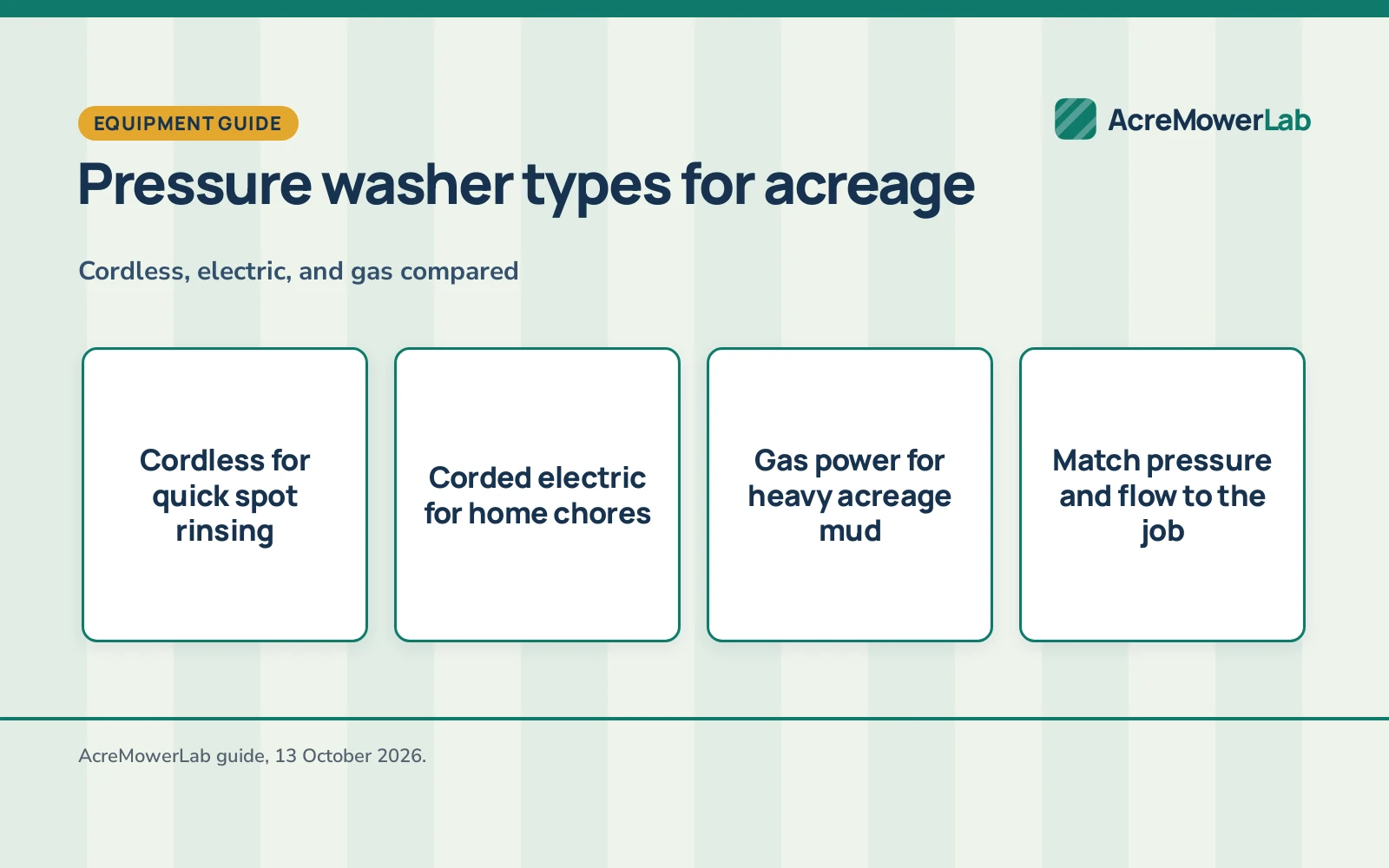
Maintaining a rural property of 1 to 10 acres means dealing with mud on tractor decks, red clay on utility trailers, and grime along fence lines and driveways. Choosing between the primary pressure washer types comes down to power source, water flow, and mobility: cordless battery units handle quick spot washing away from outlets, corded electric machines tackle domestic chores around the house and garage, and gas-powered pressure washers deliver the volume and pressure needed for heavy machinery and stubborn farm grime. Understanding how these pressure washer types differ helps you select the right machine for your acreage workload without overspending or falling short on power.
AcreMowerLab earns a commission when you shop through links here. It never changes your price. Affiliate disclosure.
Pressure washer types: how the main categories compare
| Type | Best for | Limit |
|---|---|---|
| Cordless battery power washer | Rinsing yard tools, mountain bikes, patio furniture, and spot cleaning away from water taps | Lower pressure ratings and limited runtime per battery charge |
| Light-duty corded electric | Washing personal vehicles, garage floors, deck boards, and house siding near an electrical outlet | Tethered to a power cord with moderate water volume |
| Heavy-duty corded electric | Driveways, barn walkways, and equipment rinsing with push-button starts and zero engine upkeep | Requires dedicated electrical circuit and higher power draw |
| Residential gas pressure washer | Long driveways, farm implements, utility trailers, and heavy mud buildup across acreage | Requires gasoline, engine oil maintenance, outdoor operation, and winter care |
| Commercial gas pressure washer | Stripping peeling paint, large concrete pads, heavy farm machinery, and daily property cleanup | Heavier steel frames, higher fuel usage, and greater equipment weight |
Most property owners find that matching the machine to their most demanding cleanup chore prevents frustration. For dedicated equipment reviews, see our gas pressure washer guide and our roundup of light duty pressure washer models.
Step 1: understand power sources and mobility
Power source dictates where you can work, cleaning force, and maintenance needs. Pressure washer types split across distinct formats:
Cordless battery models: Battery power washers prioritize mobility over raw stripping force. Handheld units draw water from a bucket or garden hose. For example, the YKYI cordless washer pairs a 21V 4000mAh (4.0Ah) battery and a 300W motor with a 24FT hose to deliver 1200 PSI and 3 GPM across 30 pressure levels with 60 to 90 minutes of runtime. These excel for spot rinsing muddy boots or field equipment far from electrical outlets.
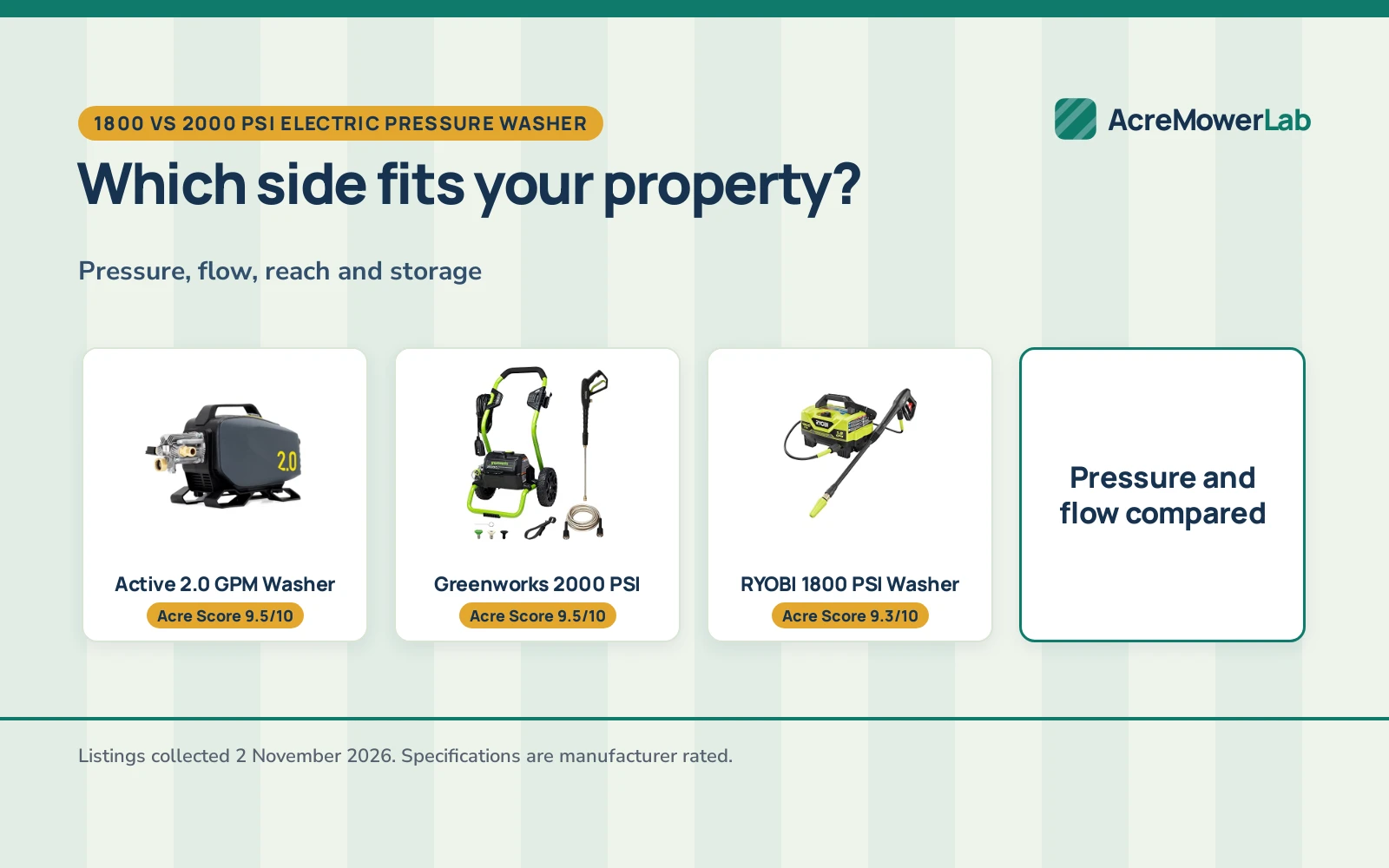
Corded electric models: Corded electric pressure washers offer quiet operation and push-button starts with zero exhaust. Compact units like the Sun Joe SPX100-GO with a 13-Amp motor produce 1800 psi using a 20-ft hose and a 35-ft GFCI power cord at just 14.33 lbs. Larger brushless units like the Greenworks machine with a 14 Amp motor generate 3000 PSI and 2.0 GPM with a 25-FT hose. Electric units suit chores around garages and workshops.
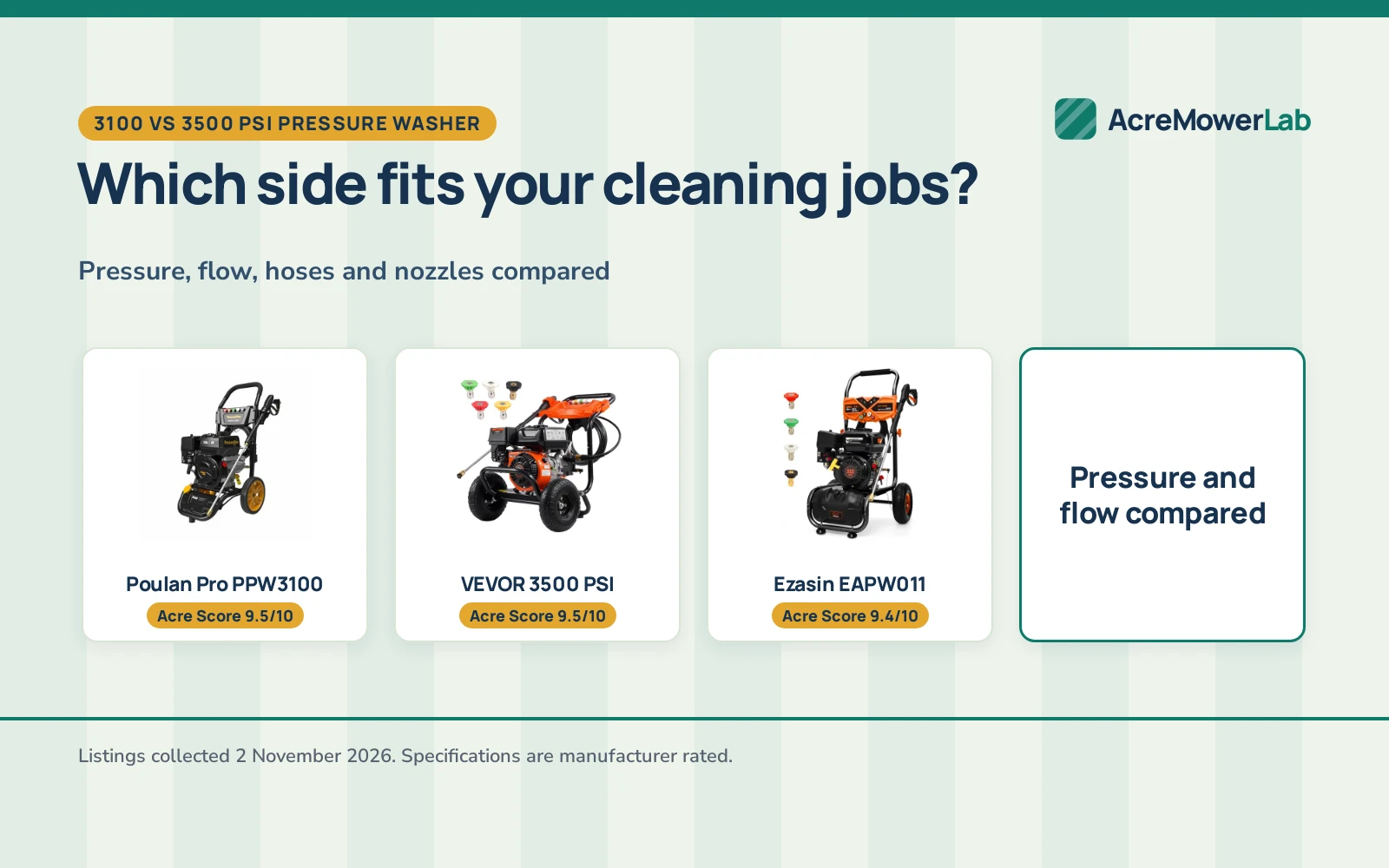
Gas-powered models: For heavy acreage grime, gas engines deliver unmatched power. The NOVUS washer features a 4-cycle 212cc engine delivering 3500 PSI at 2.6 GPM with a 30 ft hose and 10″ wheels. Similarly, the VEVOR model provides 3600 PSI and 2.6 GPM with a 26 ft hose and two 10-inch wheels, while heavy-duty units like the IvyBess machine use a 7HP 4-stroke 212CC engine producing 4200 PSI and 4.0 GPM with a 25ft hose.
Step 2: balance pressure and water flow rate
Pounds per square inch (PSI) measures stripping pressure to lift caked grime, while gallons per minute (GPM) measures rinsing flow to wash debris away.
Cleaning units (CU) provide a measure of overall cleaning capability. While calculated as PSI multiplied by GPM, stated ratings in listings do not always equal the product of peak figures: for instance, the Greenworks listing claims 3000 PSI and 2.0 GPM while publishing a rating of 3300 cleaning units. While high pressure cuts through dirt, higher flow rates like 2.6 GPM or 4.0 GPM clear broad surfaces much faster. For details, see our guides on what PSI pressure washer do I need and what size pressure washer do I need.
Step 3: compare pump designs and materials
Pump construction influences operating life and heat management under sustained property workloads:
Axial cam designs: Many pressure washers utilize axial cam pumps where pistons stroke via an angled plate. These pumps are compact and sealed for low maintenance. For instance, the NOVUS 3500 PSI washer features an aluminum axial cam pump paired with its 212cc engine, and the IvyBess 4200 PSI machine incorporates an axial cam pump alongside its 212CC engine for heavy-duty cleaning.
Pumps with heavy-duty metal components: Demanding acreage chores benefit from durable pump materials that dissipate heat. For example, the VEVOR model delivering 3600 PSI features a full copper pump designed to maintain strength and reduce pump damage from heat or pressure fluctuations during frequent cleaning. For daily or fleet washing, explore options in our commercial grade pressure washer guide.
Step 4: select spray nozzles and quick-connect accessories
Quick-connect nozzles shape water stream to prevent surface damage, connecting via standard 1/4″ fittings like the wand on the IvyBess unit:
- 0° (Red): Pinpoint jet for tough spot work on steel implements or concrete cracks. Never use on wood or painted panels.
- 15° (Yellow): Chisel spray best for stripping caked mud from mower decks and tractor rims.
- 25° (Green): General wash fan safe for wood decks, utility trailers, and fencing.
- 40° (White): Wide rinse spray ideal for vehicles, windows, and outdoor furniture.
- Detergent application: Applying soap requires low pressure. Units with an onboard tank, such as the 0.53-gal soap tank on the NOVUS washer or the 3L tank on the IvyBess machine, use a dedicated soap nozzle. Other machines apply soap through a dedicated foam bottle, such as the 13.53 oz bottle on the Sun Joe SPX100-GO or the 600ml foam bottle on the ETOOLAB model.
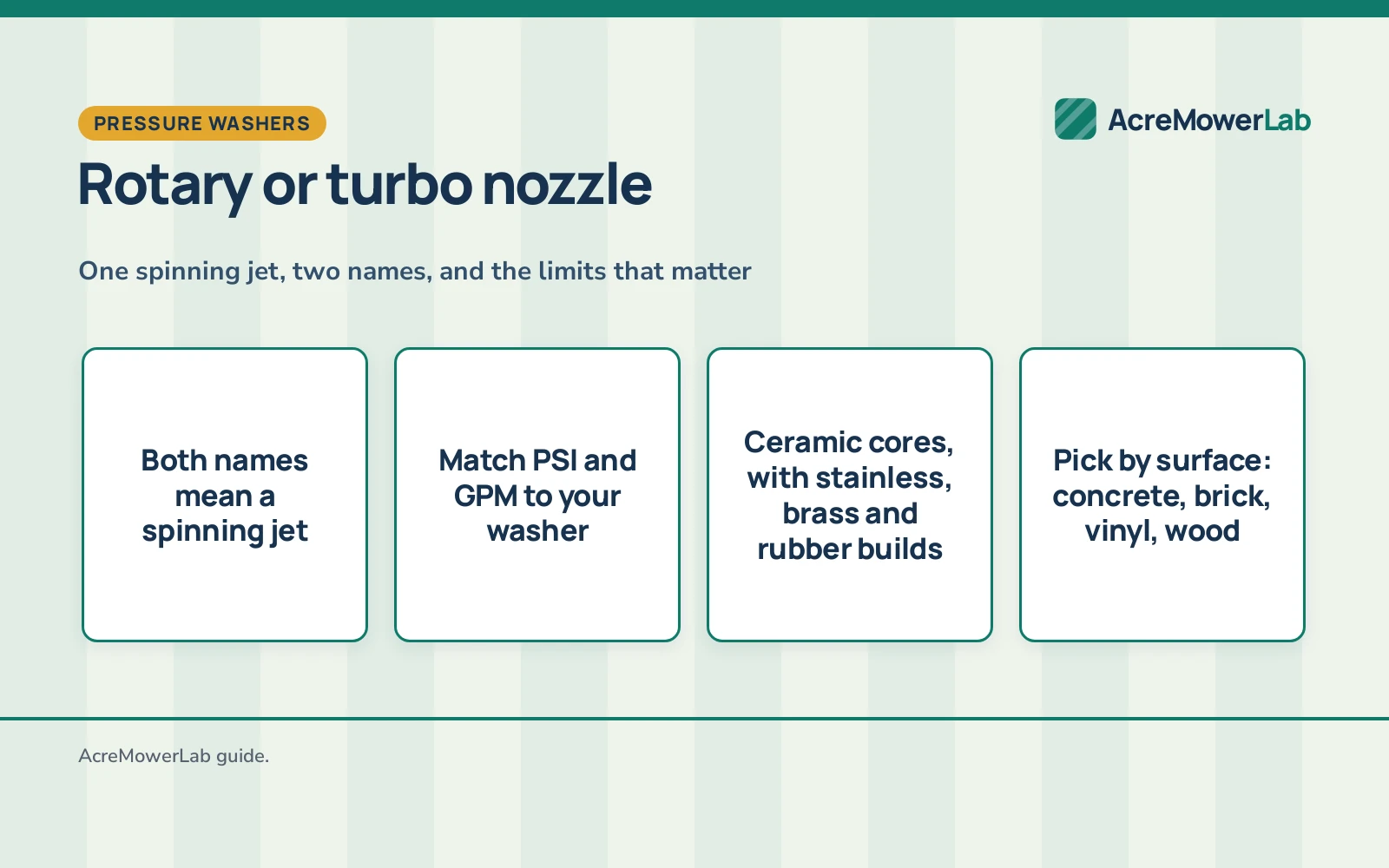
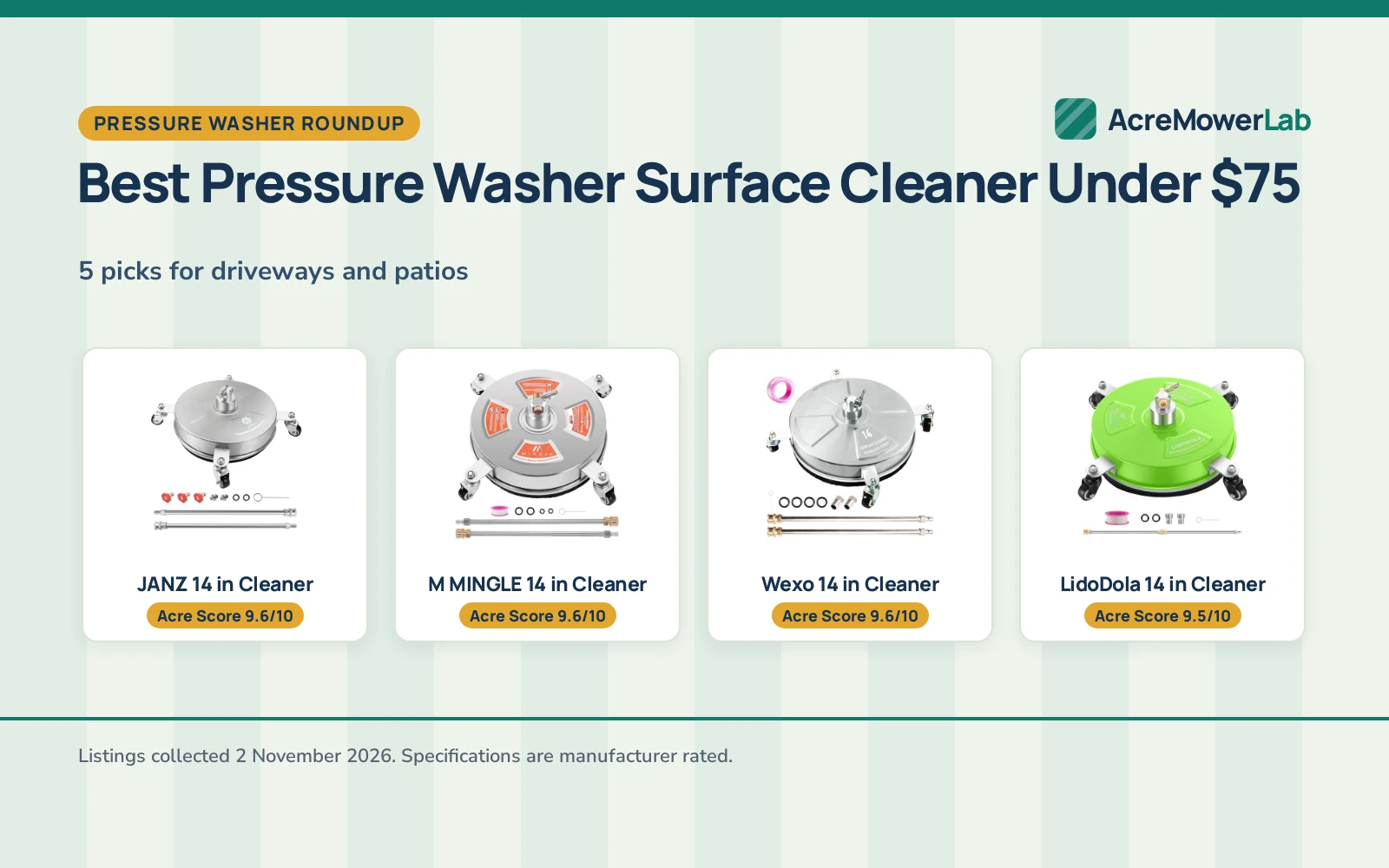
Adding a rotary pressure washer surface cleaner cleans wide driveways evenly without streaking.
Matching pressure washer types to acreage chores
Different tasks across 1 to 10 acres favor specific pressure washer capabilities:
Mower decks and implements: Flushing wet grass from mower decks requires water volume. A gas machine delivering 2.6 GPM or 4.0 GPM with a 15° nozzle strips caked clippings faster than electric models.
Outbuildings and siding: Washing vinyl siding and barn walls calls for broad coverage over sheer force. A wide-fan 25° or 40° nozzle on a moderate-pressure washer cleans siding and walls without stripping sound paint when held at a proper distance.
Remote property rinsing: Cleaning mud from utility equipment where water hoses cannot reach favors a cordless battery washer drawing from a bucket.
Water supply and pump protection on rural property
Rural wells must deliver adequate continuous flow. A gas unit rated at 4.0 GPM requires a water supply matching that volume; starved pumps suffer cavitation that ruins seals rapidly. Check that your spigot delivers steady flow into a bucket before operating. Additionally, mind inlet water temperature: the Greenworks listing states a maximum inlet water temperature of 104°F (40°C), as exceeding rated intake temperatures degrades standard pump seals.
Winter storage and seasonal care
Freezing water splits pump housings and manifolds. Before freezing weather, flush pump protector antifreeze through the water inlet until clean fluid exits the discharge. For gas engines, shut off fuel and run carburetors dry, or add fuel stabilizer. Store lithium batteries in a heated workshop. Read our guide to pressure washer maintenance for full seasonal care steps.
Safety rules for high-pressure washing
High-pressure jets present serious injection risks. Observe these fundamental rules:
- Never point the spray wand at people or animals. Even 1200 PSI spray can pierce skin and cause deep tissue damage.
- Operate gas-powered washers outdoors only. Engine exhaust contains deadly carbon monoxide fumes that build up rapidly indoors.
- Allow gas engines to cool completely before refueling to prevent spilled gasoline from igniting on hot engine components.
- Wear protective safety glasses, hearing protection, and sturdy boots against flying gravel and debris.
- Connect electric models only to GFCI outlets; units like the Sun Joe SPX100-GO include a 35-ft GFCI power cord for shock protection.
- Trigger the spray gun to release residual line pressure before uncoupling hoses or nozzle tips.
FAQ: mowing large lots
Which pressure washer type is best for cleaning farm equipment?
Gas-powered pressure washers delivering 3500 PSI or 4200 PSI with 2.6 GPM to 4.0 GPM provide the pressure and water flow needed to flush heavy clay, dried mud, and grease from tractors and implements.
Can an electric pressure washer clean concrete driveways effectively?
Electric pressure washers rated around 3000 PSI can clean concrete patios and walkways effectively, especially when paired with a surface cleaner. However, many residential electric units offer lower water flow than high-volume gas machines, so washing a long acreage driveway takes more time.
What is the difference between cordless power washers and standard pressure washers?
Cordless power cleaners operate at lower pressure, such as 1080 psi or 1200 PSI, relying on rechargeable batteries for portable spot rinsing. Standard corded electric and gas pressure washers produce higher working pressure to strip stubborn grime and deep-clean broad surfaces.
Can I run a pressure washer from a gravity-fed water tank or rain barrel?
Most standard pressure washers require a pressurized spigot to prevent pump cavitation. However, specific self-priming models, including certain cordless washers with filtered hoses and electric units like the ETOOLAB model, can draw water directly from a bucket or container.
Why is water flow rate just as important as pressure rating?
Pressure (PSI) strips stubborn grime from surfaces, but water volume (GPM) carries loosened debris away. High pressure with low flow leaves you pushing dirt back and forth instead of clearing surfaces quickly.
More mowing guides
- Best Gas Pressure Washer: 3 Picks for Farm and Acreage Cleanup
- Best Light Duty Pressure Washer (2026): 5 Picks Compared
- What PSI Pressure Washer Do I Need?
- Pressure Washer Maintenance: Step-by-Step Care Guide
Explore our pressure washer guides to compare ratings and features for your acreage.