Zero Turn Lawnmowers Pros and Cons (2026)
A practical breakdown of zero-turn mower advantages and drawbacks on acreage: cutting speed, turning agility, slope limits, towing, and upkeep costs.

On this page
Top picks at a glance
As an Amazon Associate I earn from qualifying purchases.
- 1
 Husqvarna MZ619.7/10View on Amazon
- 2
 EGO Power+ Z6 Zero Turn Electric Riding Lawn Mower9.6/10View on Amazon
- 3
 EGO Power+ Z6 Zero Turn Electric Riding Lawn Mower9.6/10View on Amazon
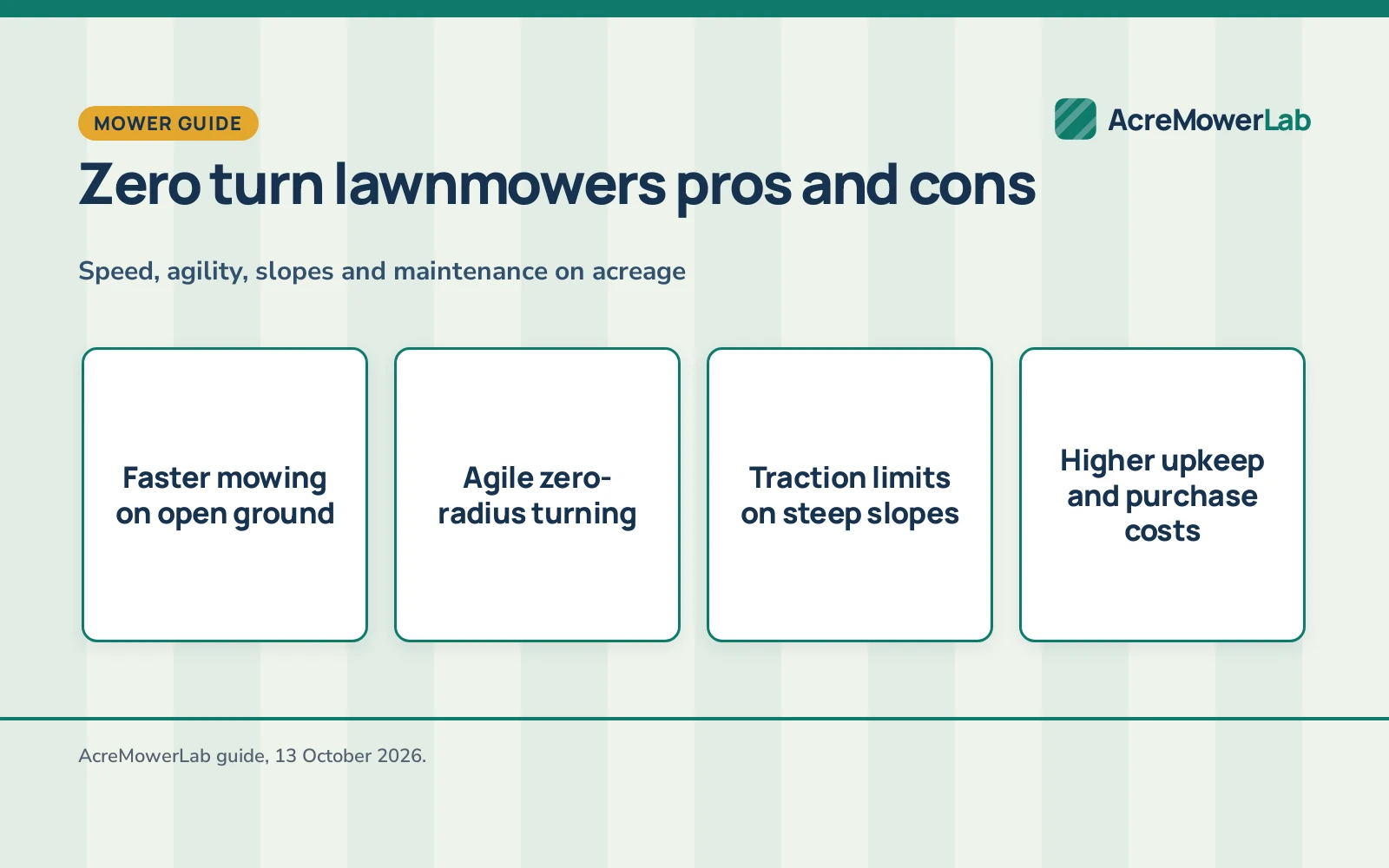
Maintaining expansive rural acreage with mixed turf, rough pasture grass, and scattered trees requires equipment matched to the land. When deciding whether to upgrade from a standard lawn tractor, understanding zero turn lawnmowers pros and cons helps you make the right investment. The primary pros of a zero-turn mower are fast cutting speeds, precise turning agility around fence lines and garden beds, and reduced mowing hours on open terrain. The main cons are poor traction and steering control on steep slopes or wet grass, a higher purchase and maintenance cost, and the risk of turf tearing during sharp pivots.
AcreMowerLab earns a commission when you shop through links here. It never changes your price. Affiliate disclosure.
Zero turn lawnmowers pros and cons: the main tradeoffs
| Evaluation Factor | Zero-Turn Advantages (Pros) | Zero-Turn Drawbacks (Cons) |
|---|---|---|
| Mowing Speed | High ground speeds cut mowing hours on large open lawns | Firm ride over bumpy ground and rough pastures |
| Maneuverability | Zero turning radius circles cleanly around trees, posts, and garden beds | Rapid pivots can scuff or tear damp turf |
| Slope Stability | Stable and responsive on flat lawns and gentle grades | Rear drive wheels lose steering traction on steep hills and wet banks |
| Steering System | Independent lap bars provide responsive directional control with practice | Dual levers require continuous grip and take time for beginners to master |
| Trimming Efficiency | Deck trims close to obstacles, reducing follow-up string trimmer work | Front caster wheels can jar or drop into ruts and animal burrows |
| Towing and Utility | Pulls light utility carts and spreaders when fitted with an approved hitch | Not engineered for ground-engaging attachments or heavy hauling |
| Long-Term Upkeep | Commercial-style welded decks and twin transmissions deliver long service life | More service points, transmission cooling upkeep, and higher replacement costs |
A zero-turn machine delivers major productivity gains on acreage, but it is not the ideal tool for every yard layout. For an overview of how zero-turns differ from traditional tractors, see our guide on why are zero turn mowers better and explore our full category of zero-turn mowers.
Weigh mowing speed against rough terrain
The primary advantage of a zero-turn mower is forward cutting speed. With a low center of gravity and wide deck, it travels faster across open turf than a lawn tractor, significantly reducing mowing hours on expansive acreage.
However, speed brings a physical tradeoff. Standard residential zero-turns use rigid steel frames without front suspension, transferring bumps from rough pasture directly to the operator. In reference listings, the Husqvarna Z254F combines a 54-inch fabricated deck with a 24-horsepower 726cc engine to sustain clean cutting across flat ground. To choose the right deck width, read our guide on what size zero-turn you need.
Assess yard obstacles and turning agility
Maneuverability is where zero-turn mowers excel. Dual hydrostatic transmissions power the rear wheels independently. Pushing one lever forward while pulling the opposite back counter-rotates the machine on its axis, while pushing one lever with the other in neutral pivots around a stationary wheel. Both motions circle cleanly around fence posts, landscaping beds, and trees without multi-point turns.
This agility brings the deck flush against borders, minimizing follow-up string trimming. However, rapid zero-radius turning risks turf tearing. Pivoting on a stationary tire grinds it into damp soil, and aggressive counter-rotation scrubs tire tread across grass crowns. Preserving turf requires a wider Y-turn that maintains forward roll on both wheels.
Inspect slopes, hills and traction limits
Slope performance is the primary limitation of a zero-turn mower. Because front caster wheels swivel freely without steering links or brakes, directional control and braking depend entirely on rear drive tires.
Traversing across a slope causes casters to drift downhill. If rear tires slip on wet grass, loose soil, or steep grades, the operator loses steering and braking, risking slides toward ditches or ponds. Manufacturers instruct operators to drive straight up and down allowable slopes and avoid damp hills entirely. Traditional lawn tractors feature mechanically linked front steering for firmer hill control. Read our review of whether are zero turn mowers safe on hills.
Factor in machine weight and storage space
Zero-turn mowers are heavy, wide machines requiring dedicated storage space and sturdy transport gear. Sturdy frames, twin transaxles, and thick steel decks add substantial mass over basic riders.
Reference data illustrates these proportions. The Husqvarna Z254F lists an item weight of 595 pounds with dimensions of 75 inches long by 67 inches wide and 40 inches high. The heavier Husqvarna Z254FX lists 780 pounds with dimensions of 75 inches long by 56 inches wide and 40 inches high. Storing a 54-inch deck requires ample clearance through shed doors and gates. Machines in this weight class, such as the 595-pound and 780-pound reference models, need heavy-duty ramps for trailer transport and can leave ruts in soft spring ground.
Evaluate towing capacity and attachments
While a zero-turn mower can tow light yard carts or spreaders with an approved hitch, utility hauling is not its core strength. Pulling heavy loads strains hydraulic wheel motors and overheats transmission fluid.
Furthermore, because front casters have no brakes, towing down an incline can push the mower rear and break drive traction. Garden tractors with heavy-duty transaxles remain superior for heavy hauling and ground-engaging tools. For hitch rules and weight limits, read our guide on whether can a zero turn pull attachments.
Consider operator controls and the steering learning curve
Switching from a steering wheel to lap bars involves a distinct learning curve. Zero-turn steering relies on coordinated lever pressure: pushing both forward drives ahead, pulling back reverses, and differential pressure turns the mower. For beginners, hydraulic response can feel abrupt.
Lap-bar steering requires continuous grip on both levers during travel. Unlike a tractor where an operator can steer with one hand while clearing a low branch, releasing one lever causes a zero-turn to veer off course. Operators must pull levers to neutral to stop before handling obstacles. For operation steps, read our guide on how to use a zero-turn mower.
Account for maintenance costs and dual transmissions
A zero-turn mower has more mechanical components than a standard tractor. Instead of a single shared transaxle, it relies on independent wheel motors or twin integrated transaxles, an electric clutch, drive belts, and pivoting casters.
This design increases long-term upkeep. Owners must keep transaxle cooling fans clear of debris, grease caster spindles, inspect drive belts, and check fluid on serviceable commercial units. Hydraulic replacements outside warranty are costly. To prevent repairs, see our review of common problems with zero-turn mowers and read our overview where zero turn transmission types explained covers drive configurations.
Match deck width to property layout
Selecting the right deck size balances cutting efficiency against yard terrain. For example, reference listings feature a 54-inch fabricated cutting deck, allowing wide passes across open acreage.
However, wide decks require smooth ground. Rolling swales or berms can cause a wide deck to scalp high spots while missing dips. Anti-scalp gauge wheels help prevent gouging, and adjustable linkages tailor cut height to turf growth. Reference listings state 6 cutting height positions, with minimum heights down to 1 inch on select models, allowing customized cutting heights.
Safety
Safe zero-turn operation requires strict compliance with manufacturer limits. Never exceed the maker’s maximum slope rating in your manual. Zero-turn mowers lose traction rapidly on slopes and near retention ponds, drainage ditches, and embankments, requiring a generous buffer from drop-offs.
Where equipped, keep roll-over protective structures fully deployed and fasten the seat belt. Never carry passengers, and keep children, pets, and bystanders completely clear of the yard. Always disengage mower blades before traveling in reverse. Wear wrap-around eye protection, hearing protection, and sturdy footwear, and clear debris before cutting. Refuel outdoors only with the engine off and cool. See our Safety Disclaimer.
FAQ: mowing large lots
How much does a zero turn mower weigh?
Weight depends on frame build, engine size, and deck construction. In reference listings, the Husqvarna Z254F states an item weight of 595 pounds with a 54-inch fabricated deck and a 24-horsepower engine. The heavier Husqvarna Z254FX states 780 pounds with a 54-inch fabricated steel deck and a 22-horsepower engine. Commercial models with heavier steel frames weigh more.
Can zero turn mowers pull a trailer?
Yes, many zero-turns pull light utility carts when equipped with an approved rear hitch. However, towing capacity is limited compared to lawn tractors. Heavy loads strain hydraulic motors and overheat transmissions. Tow only light yard waste or tools on flat ground, and avoid towing on slopes or wet turf where steering traction can fail.
How to steer a zero turn mower for beginners?
Lap bars regulate independent rear wheel motors. Push both levers forward smoothly to travel straight, ease pressure on the left lever to steer left, and pull both to neutral to stop. Beginners should practice in a wide, flat open area away from obstacles until control feels natural.
Can zero turn mowers cut high grass?
Zero-turn mowers can cut tall grass with proper technique. Set the deck to its highest position for an initial pass, discharge clippings away from standing grass, and travel at a modest pace. Follow up with a second pass at normal cutting height once clippings settle.
How to fix a flat tire on a zero turn mower?
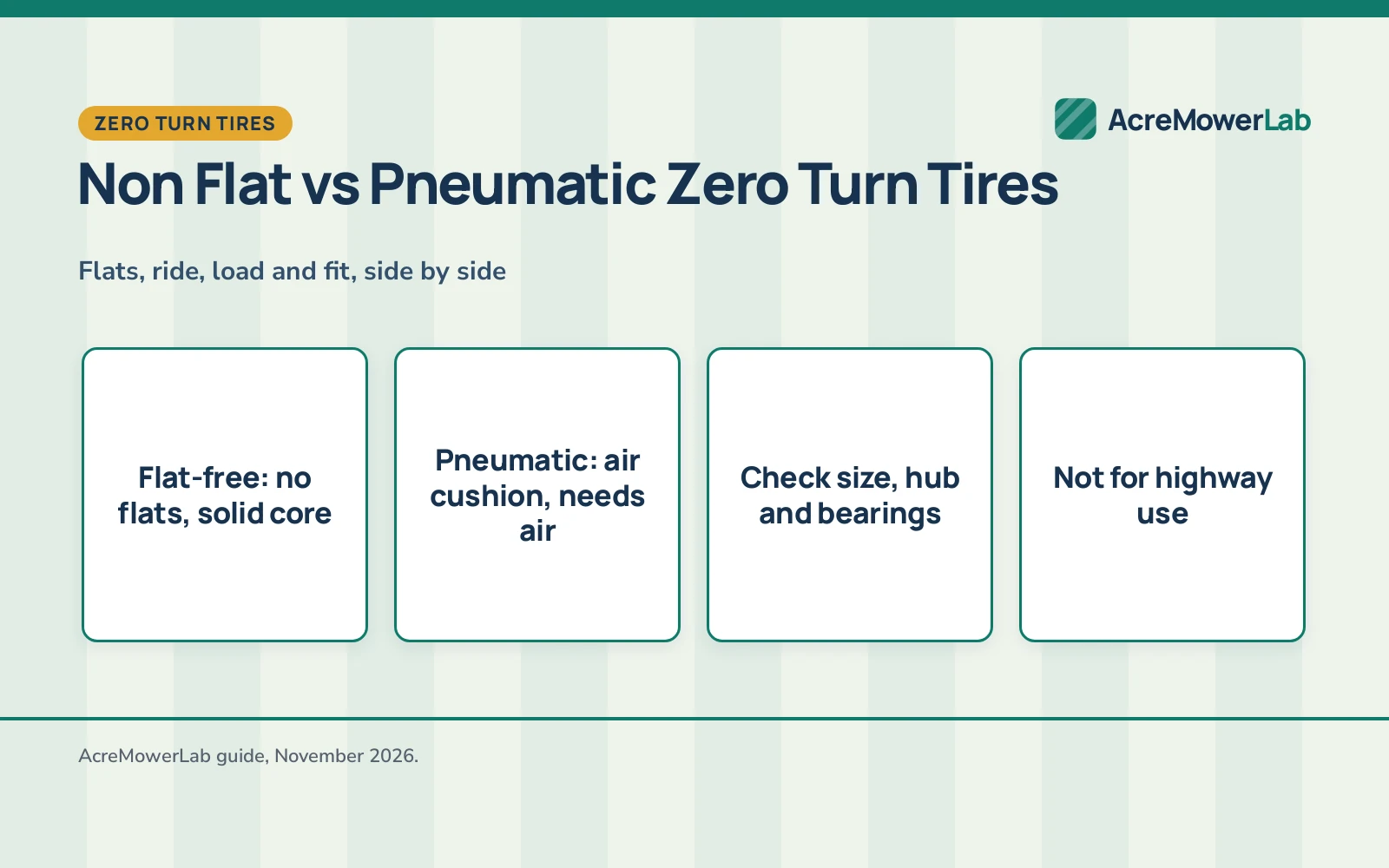
Park on level ground, set the parking brake, and shut off the engine. For small tread punctures, install a tire plug or inject sealant through the valve stem and reinflate. For bead leaks or severe tire damage, safely lift the mower with a jack, remove the wheel, and repair or replace the tire per manual specifications.
More mowing guides
- Why Are Zero Turn Mowers Better?
- Are Zero Turn Mowers Safe on Hills?
- What Size Zero Turn Do I Need for My Acreage?
- Can a Zero Turn Pull Attachments?
Use the Mower Matcher to narrow down choices by acreage, terrain, budget, and power type.