Garden Fork vs Tiller: Which One Should You Buy?
Garden forks and tillers compared on tines, handles, power and working width, with two examples of each side from the listings reviewed.

On this page
Top picks at a glance
As an Amazon Associate I earn from qualifying purchases.
- 1
 Truper Spading Fork, 4-Tine Steel Head, 30-Inch Wood D-Handle9.5/10View on Amazon
- 2
 GarveeTech 52CC Gas Tiller, 4-Tine Cultivator9.5/10View on Amazon
- 3
 Truper Tru Pro 4-Tine Spading Fork, 30-Inch Fiberglass Handle with D-Grip9.5/10View on Amazon
- 4
 YEELOR 3-Tine Long Handle Tiller Garden Cultivator9.4/10View on Amazon
Verdict: Choose a garden fork if the work is turning, loosening and aerating soil, compost and mulch around beds and planting areas by hand. Choose a tiller if the work is preparing beds and plots: the gas example for powered work on larger ground, or the manual example for small plots and flower pots.
A property with beds to turn and ground to prepare raises the garden fork vs tiller question every spring. Both tools break soil, but they do it differently: a fork lifts and turns soil with tines and leverage, while a tiller breaks ground with a set of tines. This comparison covers what separates the two sides, then four examples from the listings reviewed, two forks and two tillers.
AcreMowerLab earns a commission when you shop through links here. It never changes your price. Affiliate disclosure.
The examples
Truper Spading Fork, 4-Tine Steel Head, 30-Inch Wood D-Handle
A 4-tine steel spading fork with a 30 in wood D-handle for turning, loosening and aerating soil, compost and mulch.
The Truper 30293 is a straightforward spading fork: a 4-tine steel head, a 30 in wood D-handle and a stated 7 in head width, listed for turning, loosening and aerating soil, compost and mulch, and working around beds and planting areas. The listing backs Truper TRU-TOUGH tools with a 10 year replacement warranty.
Pros
- 4-tine steel head for turning, loosening and aerating
- 30 in wood D-handle for secure control
- 7 in head width stated for working around beds
- 10 year replacement warranty stated
Cons
- Manual tool, pace is limited to the user
- No tilling depth stated
- No safety certification stated
- No tine length stated
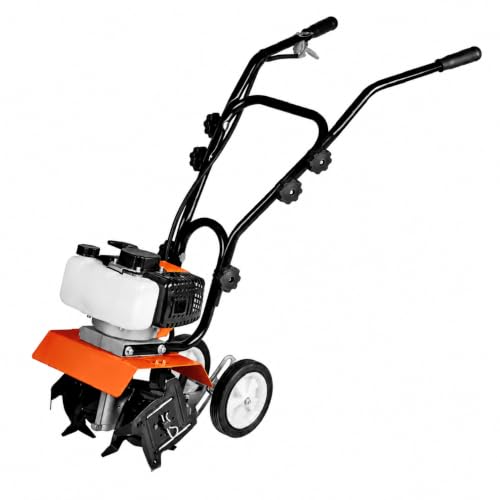
GarveeTech 52CC Gas Tiller, 4-Tine Cultivator
A 52CC 2-stroke gas tiller with four steel tines, an adjustable skid, 5.8 in wheels and heat dissipation vents for vegetable gardens, flower beds and home soil work.
The GarveeTech example is the only powered tool here: a 52CC 2-stroke engine the listing describes as EPA-certified, four heavy-duty steel tines, an adjustable skid, 5.8 in wheels, heat dissipation vents and an air filtration system. One contradiction sits inside this listing: the title states an 11.8 in width and a 3.9 in depth, while the bullets state 13.8 in and 4.7 in.
Pros
- 52CC 2-stroke engine for powered soil preparation
- Four steel tines with an adjustable skid
- EPA-certified engine stated
- 5.8 in wheels and handle-mounted controls
Cons
- Working width stated two ways: 11.8 in and 13.8 in
- Tilling depth stated two ways: 3.9 in and 4.7 in
- Fuel and engine upkeep, unlike the manual tools
- No warranty term stated
Truper Tru Pro 4-Tine Spading Fork, 30-Inch Fiberglass Handle with D-Grip
A 4-tine forged steel spading fork with diamond-point tines, a 30 in fiberglass handle with D-grip and a reinforced socket, listed for professional contractors and agricultural use.
The Tru Pro is the heavier-duty fork of the pair: a forged steel head with sharp, diamond-point tines described as designed for maximum soil penetration, a 30 in fiberglass handle the listing describes as outlasting traditional wood in heavy-duty environments, an ergonomic D-grip and a reinforced socket.
Pros
- Forged steel head with sharp diamond-point tines
- 30 in fiberglass handle, listed as weather resistant
- Reinforced socket between head and handle
- Listed for professional contractors and agricultural use
Cons
- Manual tool, pace is limited to the user
- No head width stated
- No tilling depth stated
- Warranty named with no term stated
YEELOR 3-Tine Long Handle Tiller Garden Cultivator
A manual 3-tine garden cultivator with a 15.5 to 55 in adjustable handle for tilling, loosening soil, weeding and fertilizing in plots and flower pots.
The YEELOR example is a tiller in name and a hand tool in practice: a manual 3-tine cultivator in steel with an anti-rust coating, an adjustable handle from 15.5 in to 55 in, and a push and pull action the listing describes as easy and labor-saving.
Pros
- Adjustable handle from 15.5 in to 55 in
- Steel with an anti-rust coating
- Suits large plots and small flower pots
- No fuel or engine upkeep
Cons
- Manual tool, pace is limited to the user
- Only 3 tines against 4 on the other examples
- No working width stated
- No warranty term stated
Other machines to compare
 Lilyvane Garden ForkCheck price on Amazon
 Pitch ForkCheck price on Amazon
 Garden ForkCheck price on Amazon
 Ymachray Garden ForkCheck price on Amazon
 Owlett Garden Hand ForkCheck price on Amazon
 Sun Joe Electric Corded Garden Tiller & CultivatorCheck price on Amazon
Garden fork vs tiller side by side
| Factor | Garden fork (Truper 30293) | Tiller (GarveeTech 52CC) | Garden fork (Tru Pro BJ-4F) | Tiller (YEELOR 3-Tine) |
|---|---|---|---|---|
| Tool type | Manual 4-tine spading fork | 52CC 2-stroke gas cultivator | Manual 4-tine spading fork, forged steel | Manual 3-tine hand cultivator |
| Tines | 4 steel tines | 4 steel tines | 4 forged steel diamond-point tines | 3 steel tines |
| Handle | 30 in wood D-handle | Stand-up operation, handle-mounted controls | 30 in fiberglass D-grip | 15.5 to 55 in adjustable handle |
| Working width | 7 in head width | 11.8 in in the title, 13.8 in in the bullets | Not stated | Not stated |
| Tilling depth | Not stated | 3.9 in in the title, 4.7 in in the bullets | Not stated | Not stated |
| Power | Manual | 52CC 2-stroke gas, EPA-certified | Manual | Manual |
| Weight (spec table) | 3.75 pounds | 37.48 pounds | 1.6763 Pounds | 2.12 pounds |
| Warranty | 10 year replacement warranty | Not stated | Warranty named, no term stated | Not stated |
| Best at | Turning, loosening, aerating soil, compost, mulch | Preparing vegetable gardens, flower beds, home soil work | Professional and agricultural digging and aerating | Tilling, loosening, weeding in plots and flower pots |
Figures are manufacturer stated for the four example models, collected 4 November 2026.
Manual or powered: the real split
Both fork examples are manual tools, driven by the user. The tiller side is split: the GarveeTech example runs a 52CC 2-stroke gas engine with an EPA-certified engine, while the YEELOR example is a manual hand cultivator with no engine at all. So the real split is hand leverage against engine power, and the manual tiller sits on the fork side of that line.
Tines and working width
Both forks carry 4 tines, and the gas tiller carries four steel tines as well. The manual YEELOR tiller carries 3 tines. Fork tines lift and turn, while tiller tines break ground as the tool moves, so tine count alone does not pick a winner.
Width does not compare directly across the sides. The Truper 30293 listing states a 7 in head width, which is the width of the fork head. The GarveeTech listing states a working width two ways, 11.8 in in the title and 13.8 in in the bullets, so the width is unclear until the listing is checked. No working width is stated for the Tru Pro fork or the YEELOR tiller.
Handles and control
Both forks use a 30 in handle with a D-grip, but the materials differ: wood on the 30293, and fiberglass on the Tru Pro, which the listing describes as industrial-strength and weather resistant, outlasting traditional wood in heavy-duty environments. The Tru Pro also adds a reinforced socket between head and handle. The gas tiller is built for stand-up operation with handle-mounted controls, an adjustable skid and 5.8 in wheels, while the manual tiller uses a 15.5 in to 55 in handle, worked with a push and pull force.
What each side can do
The fork examples suit turning, loosening and aerating soil, compost and mulch, breaking up soil, moving compost and working around beds and planting areas. The Tru Pro listing extends that to professional contractors and agricultural use. The tiller examples suit preparing ground: the GarveeTech listing names vegetable gardens, flower beds and home soil work, while the YEELOR listing names tilling, loosening, aerating, weeding and breaking up soil. Depth is stated only on the tiller side, and there it is stated two ways, so depth cannot decide this comparison.
Upkeep
A fork needs no fuel and no engine care, and the manual tiller is the same kind of tool to keep: steel with an anti-rust coating. The gas tiller is the only example with engine upkeep, with a 2-stroke engine, heat dissipation vents and an air filtration system.
Acreage and terrain fit
Truper 30293
GarveeTech 52CC
Truper Tru Pro BJ-4F
YEELOR 3-Tine
Matching It to Your Property
- For beds and planting areas, the fork examples work around plants with a 30 in handle and a D-grip.
- For open vegetable gardens and flower beds, the gas tiller example offers a 52CC engine with an adjustable skid.
- For small plots and flower pots, the manual tiller example adjusts from 15.5 in to 55 in for close work.
- For storage, the manual tools have no engine, while the gas tiller is the only example with one.
The Acre Score explained
The Acre Score weighs five factors: performance, build quality, value, safety and warranty. A factor the listing does not state scores zero. The gas tiller scores for safety on its EPA-certified engine and protective guard, and the wood-handle fork scores for warranty on its stated 10 year replacement warranty.
| Product | Acre Score | Perf. /35 | Build /25 | Value /25 | Safety /10 | Warranty /5 |
|---|---|---|---|---|---|---|
| Truper 30293 | 9.5 | 28 | 21 | 20 | 0 | 4 |
| GarveeTech 52CC | 9.5 | 30 | 21 | 20 | 5 | 0 |
| Truper Tru Pro BJ-4F | 9.5 | 30 | 22 | 20 | 0 | 0 |
| YEELOR 3-Tine | 9.4 | 26 | 20 | 21 | 0 | 0 |
We show weighted point totals as scores from a 9.2 base up to a 9.8 peak, and a larger total can never read lower.
Many owners keep both kinds: a fork for beds and compost work, and a tiller for preparing plots. For more soil preparation tools, see our tillers and cultivators.
Buried utility lines are a real risk: in the US, call 811 a few days before you dig or till new ground. Wear eye protection and sturdy boots, keep feet and hands away from the tines, and start on clear, rock-free soil. Refuel only with the engine off and cool. Read our Safety Disclaimer.
FAQ: mowing large lots
Should I pick a fork or a tiller for a small bed?
A fork, for turning and loosening around beds by hand. A gas tiller earns its place on larger plots, where working a width beats lifting one forkful at a time.
Can a manual tiller replace a gas tiller?
For small plots and flower pots, the manual YEELOR example covers tilling, loosening, weeding and aerating. For longer sessions on open beds, the gas GarveeTech example brings a 52CC engine.
What does the GarveeTech width discrepancy mean?
The title states an 11.8 in working width while the bullets state 13.8 in, and the title states a 3.9 in depth while the bullets state 4.7 in. Treat both figures as unclear until the listing is checked.
Do any of these have a warranty?
The Truper 30293 listing states a 10 year replacement warranty. The Tru Pro listing names a warranty with no term stated, and no warranty term is stated for either tiller.
Which fork suits heavy work?
The Tru Pro example, with forged steel diamond-point tines, a reinforced socket and a fiberglass handle, listed for professional contractors and agricultural use.