Lawn Mower Blade Measurement Tool: How to Measure
A lawn mower blade measurement tool reads blade height so you can set the deck level, and a balancer checks blade balance after sharpening.

On this page
Top picks at a glance
As an Amazon Associate I earn from qualifying purchases.
- 1
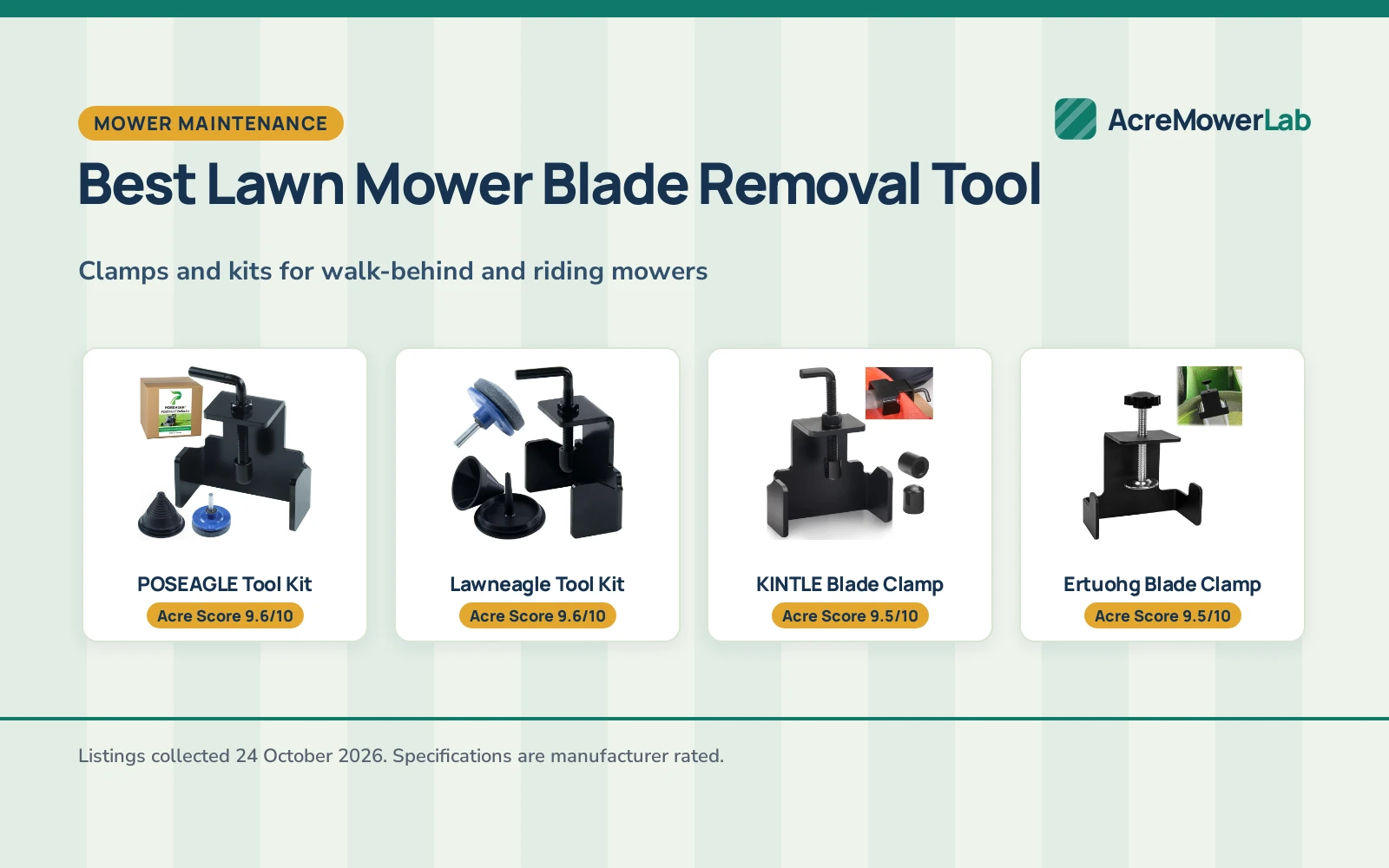
 POSEAGLE Riding Lawn Mower Blade Removal Tool with Sharpener9.6/10View on Amazon
- 2
 Lawneagle Lawn Mower Blade Removal Tool with Sharpener and9.6/10View on Amazon
- 3
 Ertuohg Universal Lawn Mower Blade Removal Tool9.5/10View on Amazon
When the lawn comes out striped with high and low passes, the deck is often out of level rather than the grass growing unevenly. A lawn mower blade measurement tool reads blade height at the deck so you can see which side sits high or low and set the deck level before the next mow. This guide shows what the tool measures, how to read it, how to use the reading to level the deck, and how a balancer checks blade balance after sharpening.
AcreMowerLab earns a commission when you shop through links here. It never changes your price. Affiliate disclosure.
Lawn mower blade measurement tool: what it measures
A deck leveling gauge is the common form of this tool. It slides under the deck and reads blade height against a marked scale. These gauges read from 1.5 to 5 inches, and some carry a dual scale of 38 to 127 mm. The reading tells you how high the blade cuts and whether the deck sits level.
| Tool | What it measures | What to check |
|---|---|---|
| Deck leveling gauge | Blade height at the deck | Scale range and a rigid arm with minimal flex |
| Blade balancer | Whether a sharpened blade balances | Center pin and step cone that fit the blade hole |
| Balance adapter set | Which blade hole shapes center on the balancer | The adapter shape that matches the blade hole |
After sharpening, a blade needs a balance check before it goes back on the mower. See the best mower blade sharpener picks and the best mower blade balancer picks for tools that go with the gauge.
Step 1: park on flat ground
Park the mower on flat, level ground and set the deck to the cutting height you mow at. The gauge base sits on the ground, so a slope under the mower throws the reading off. Clear sticks and stones from under the deck before you slide the gauge in.
Step 2: read blade height with the gauge
Slide the rigid arm under the deck until it touches the blade edge, then read the height on the scale. These gauges read from 1.5 to 5 inches. Take the reading at the blade tip, where the cut happens, and write it down before you move the gauge.
Step 3: compare left and right
Measure the blade at the left side of the deck and again at the right side, then compare the readings. A level deck gives the same reading on both sides. Compare front and rear positions as well for a balanced deck adjustment and a more even cut.
Step 4: adjust the deck and recheck
Adjust the deck by the mower manual, then measure again. Repeat the reading after each change until the left and right readings match. A gauge with a widened base stays upright on flat ground while you work, and a rigid arm keeps the reading steady.
Step 5: check blade balance after sharpening
A sharpened blade can cut unevenly if one end is heavier than the other. Set the blade on a balancer and see which end drops. The balancer base holds a center pin with a step cone, and the blade rests on the cone. Adapter sets cover 5-point, 6-point and 7-point star holes, plus t-shirt and bowtie holes, so the blade centers on the balancer instead of rocking on a rounded step.
Pick a gauge that fits your mower
Deck leveling gauges are made to replace part numbers such as John Deere AM130907 and TY15272, MTD 490-900-0041, Cub Cadet 490-900-0041 and Stens 750-442. Check the part number and the measuring range before ordering, and confirm the gauge shape fits your deck. The FINBe gauge (on Amazon) uses a yellow plastic body, measures 12.7 inches by 1.5 inches by 3.93 inches and weighs 0.28 pounds, so it stores in a toolbox drawer. See the mower maintenance guides for more deck and blade upkeep.
When to measure again
Measure again after hitting a rock or stump, after sharpening, and at the start of the mowing season. A bent blade or a deck knocked out of level shows up in the readings before it shows up in the cut. Keep the gauge in the shed with the mower tools so it is on hand when the deck needs a check.
Safety
Wear eye protection and gloves when working around blade edges. Keep hands clear of the cutting edge while sliding the gauge under the deck. Work with the engine off and cool, and keep children and pets out of the work area.
FAQ: mowing large lots
What does a lawn mower blade measurement tool measure?
Blade height at the deck, read on a scale that runs from 1.5 to 5 inches. The reading shows whether the deck sits level and how high the blade cuts.
What cutting height range do deck leveling gauges cover?
The gauges read from 1.5 to 5 inches, with a dual scale of 38 to 127 mm on models that carry both scales.
How can you check whether a mower deck is level?
Measure blade height at the left side and the right side of the deck, then compare the readings. Matching readings mean a level deck, and a difference means the deck needs adjustment.
What is a mower blade balancer for?
It checks whether a sharpened blade balances on its center hole. A blade that tips to one side is heavier on that end and can vibrate and cut unevenly.
Do deck leveling gauges fit every mower?
No. Match the part number, such as John Deere AM130907 or Stens 750-442, and the measuring range to your mower before ordering.