Manual Lawn Roller: How to Choose and Use One
A manual lawn roller presses seed and smooths bumps: how to pick the size, fill it, roll in passes and store it.

On this page
Top picks at a glance
As an Amazon Associate I earn from qualifying purchases.
- 1
 IRONMAX 17 Gallons/63 L Manual Lawn Roller9.4/10View on Amazon
- 2
 Brinly 485 lb. Tow Behind Poly Lawn Roller with Easy Turn Plug9.8/10View on Amazon
- 3
 VEVOR Tow Behind Lawn Roller9.7/10View on Amazon
A manual lawn roller is a heavy drum you push or pull across the lawn to press seed into the soil, flatten bumps and smooth ground that frost has lifted. The drum fills with water or sand, so the weight fits the job, and you drain the water out when you are done so it stays light enough to move and store. This guide covers what the drum does, how to pick the width and capacity, how to fill it, how to roll in passes, and how to put it away.
AcreMowerLab earns a commission when you shop through links here. It never changes your price. Affiliate disclosure.
What a manual lawn roller does
A roller presses the surface of the lawn flat. It pushes seed into contact with the soil after sowing, presses fresh sod down onto the soil beneath it, and smooths bumps left by frost, moles and foot traffic. A roller can also leave stripes on the lawn, since the drum bends the grass in the direction of each pass. The drum works on the surface only: it does not cut, dig or open the soil. The Garvee roller (on Amazon) and aerator is the exception in the reference listings, a 23-inch drum with spike tines that rolls and aerates in one pass.
Use a roller when the lawn needs pressing, not when it needs opening up. Seed, sod and light frost heave are roller jobs. Deep ruts, standing water and thatch are not, and rolling wet soil can make compaction worse, so wait until the ground is damp, not wet, before you roll.
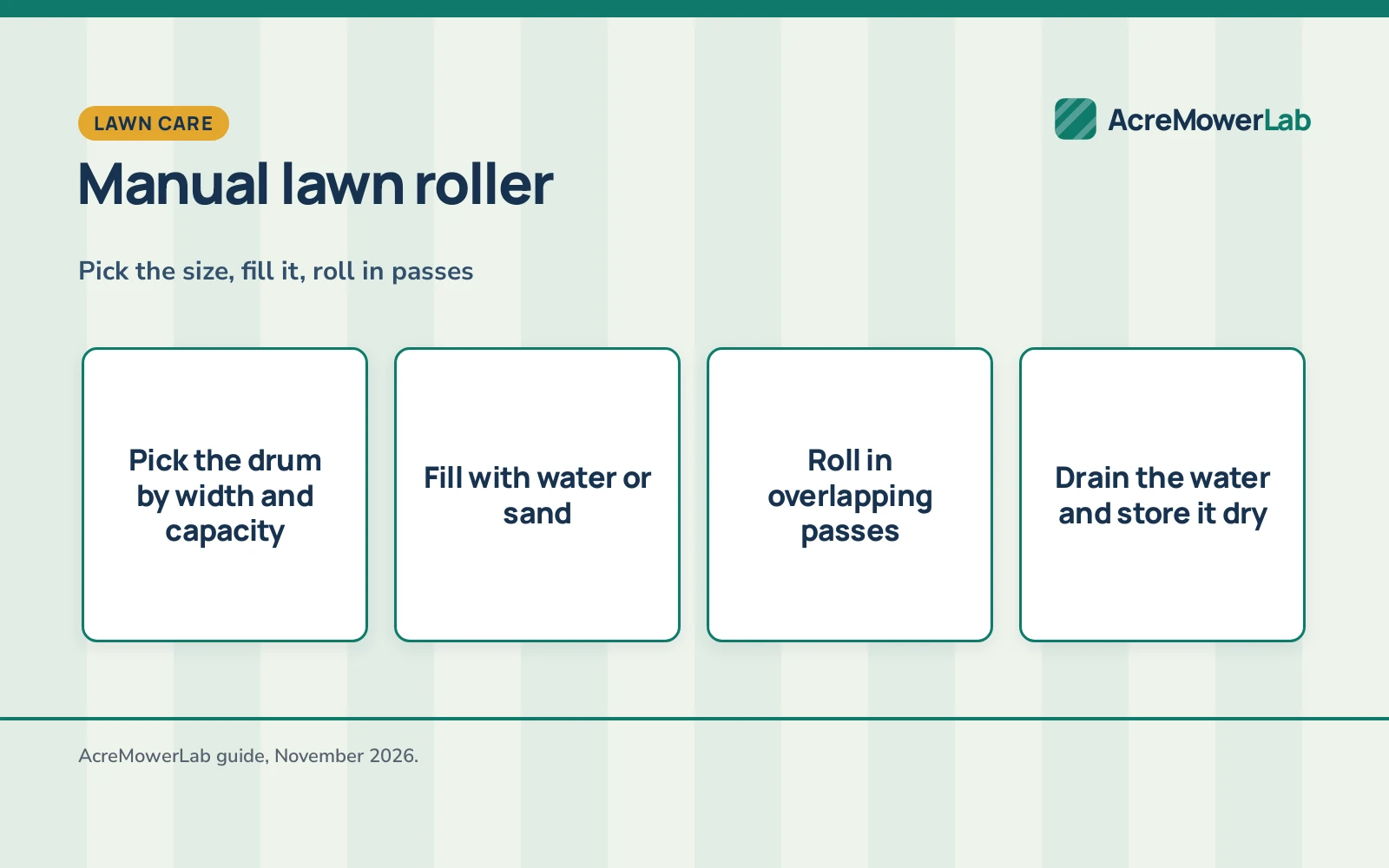
Pick the size: drum width and capacity
Two figures set the size: drum width and capacity in gallons. Widths in the reference listings run from 16 inches to 36 inches, and capacities run from 8 gallons to 30 gallons. A narrow drum turns easily in a small yard and fits through gates; a wide drum covers open ground in fewer passes but needs room to turn. Capacity sets the weight: a small drum stays light, while a large drum holds more weight for leveling.
| Roller | Drum size | Capacity |
|---|---|---|
| Goplus 12-gallon roller | 13 by 20 inches | 12 gallons |
| IRONMAX 30-gallon roller | Not stated | 30 gallons |
| ONECHOI 36-inch roller | 36 inches | 30 gallons |
| Outsunny 20-inch roller | 19.75 inches | 15.9 gallons |
| VINGLI 24-inch roller | 24 inches | 13 gallons |
| VINGLI 16-inch roller | 16 inches | 8 gallons |
| Threlaco 10-gallon roller | Not stated | 10 gallons |
| Garvee 23-inch roller and aerator | 23 inches | 13 gallons |
| IDEALHOUSE 9.5-gallon roller | Not stated | 9.5 gallons |
| JustSmart 22-inch roller | 22 inches | 9.5 gallons |
Match the drum to the lawn, not to the shed. A 16-inch drum suits a small yard with beds and corners, while a 36-inch drum suits open ground where you can turn it without stopping. For most suburban lawns, a drum in the middle of the range covers the ground without fighting the turns. Check the gate and the path to the lawn before you buy, since a wide drum still has to reach the grass.
Fill it: water or sand
The drums in the reference listings fill with water or sand, most through an inlet or drain plug, and the fill sets the working weight. Water is the easy choice: fill it at the hose, roll, then open the drain plug and let it out. Sand is heavier for the same drum and stays in the drum between jobs, which suits a lawn that needs real leveling work. The ONECHOI lists about 110 kg filled with water and about 194 kg filled with sand, with an empty weight of 16 kg, which shows how much the fill matters. The Outsunny lists 15.9 gallons for a maximum weight of 202.2 lbs.
Start light and add weight only when the lawn asks for it. Fill with water first and roll one short strip: if the bumps stay, add sand or fill the drum fuller. Never fill past the inlet, and drain the drum before you lift it or put it away, since a full drum is far heavier than an empty one.
Push, pull or tow it
Small drums are push tools. The Goplus, VINGLI, IDEALHOUSE and JustSmart rollers (on Amazon) use a U-shaped handle, and the IDEALHOUSE and JustSmart handles measure 28 inches across, which gives room for two hands and a comfortable grip. The ONECHOI uses a T-shaped handle for pushing and pulling, and it converts to a pin-style hitch for towing behind an ATV or riding mower. The IRONMAX connects to the back of a tractor with a latch and pin, and it also pushes by hand for narrow lawns.
Push for tight areas and small lawns, where you steer the drum around beds and trees. Tow for open ground, where a tractor or riding mower does the pulling and you cover the lawn in long passes. See the push roller vs tow behind roller guide for the tradeoffs, and the types of hitch pins guide before you hook a drum to a hitch.
Roll in passes
Mow first, then roll, so the drum meets short grass and you can see the bumps. Roll when the soil is damp but not wet: dry soil resists the drum, and wet soil smears and compacts. Work in long, straight passes with a small overlap, the way you mow, and roll bumpy ground a second time at a right angle to the first pass. Keep the pace slow and steady, since a fast push skips over bumps instead of pressing them down.
Keep the drum clean as you go. The Goplus, IRONMAX, Garvee, IDEALHOUSE and JustSmart rollers all list a scraper bar that clears dirt and grass from the drum while you roll. Rounded drum edges protect the grass on turns, which the Goplus, VINGLI and Outsunny listings all note. If the drum starts to slide instead of roll, stop and clear the surface before you carry on.
What a roller cannot fix
A roller presses the surface, so it cannot fix problems below the surface. Deep ruts from tires, standing water from poor drainage, and a thick layer of thatch all need other tools. A plain drum roller does not aerate: it pushes soil together, while an aerator opens holes in it. Rolling compacted soil without aerating can make the compaction worse, so aerate first if the lawn feels hard underfoot. See the rolling vs core aerator guide for the difference, and the best lawn aerator tool picks when the lawn needs holes, not pressure.
Empty, clean and store it
Empty the water out of the drum after every use. The Outsunny listing says to pour the water out when not in use, and most drums here have a drain plug for that job. Rinse mud off the drum, let it dry, and store it where it will not freeze full of water. The Goplus handle (on Amazon) hangs on a wall, and the IDEALHOUSE and JustSmart drums stand upright or hang, which keeps a small shed tidy.
Empty weights in the reference listings run from 13.45 pounds for the 16-inch VINGLI to 41.0 pounds for the IRONMAX, so even the heaviest drum moves easily once it is drained. Store the drum drained and dry, keep the drain plug where you can find it, and check the scraper bar and handle bolts at the start of the season.
Safety
Keep hands and feet clear of the drum while it rolls, and watch your footing on slopes and wet grass. Empty the drum before you lift it or carry it up steps, since a full drum is heavy enough to strain your back. Keep children and pets out of the work area, and never let anyone ride on the drum or the handle.
FAQ: mowing large lots
How heavy should a manual lawn roller be?
Heavy enough to press the bumps flat, and no heavier. The reference drums hold from 8 gallons to 30 gallons, and the ONECHOI lists about 110 kg filled with water and about 194 kg filled with sand. Start with water and add weight only if the bumps stay.
Should I fill a lawn roller with water or sand?
Water for most jobs: it fills fast, drains fast, and lets you change the weight between passes. Sand suits a lawn that needs real leveling, since the same drum weighs far more filled with sand than with water.
Can I tow a manual lawn roller behind a mower?
Some rollers tow and some do not. The IRONMAX connects to a tractor with a latch and pin, and the ONECHOI converts to a pin-style hitch for an ATV or riding mower. Push-only rollers stay on small lawns, so check the handle and hitch before you buy.
What size lawn roller do I need?
Match the drum to the lawn. A 16-inch drum suits a small yard with beds and corners, a 24-inch drum suits a typical suburban lawn, and a 36-inch drum suits open ground. Check the gate and the path to the lawn before you buy.
Do I need to empty the roller after use?
Yes. Open the drain plug and let the water out, since a full drum left standing can freeze, leak or rust. Store the drum drained and dry, standing upright or hung on a wall.
Does a lawn roller replace aerating?
No. A plain drum roller presses soil together, while an aerator opens holes in it. Roll seed and sod, and aerate compacted ground before you roll it.