What Size Riding Mower Do I Need?
A step-by-step guide to choosing the right riding mower deck size and tractor style for your lawn acreage, obstacles, and terrain.

On this page
Top picks at a glance
As an Amazon Associate I earn from qualifying purchases.
- 1
 Eparts Riding Mower Garden Tractor Seat9.4/10View on Amazon
- 2
 Greenworks 80V 42" CrossoverT Cordless Riding Lawn Tractor9.5/10View on Amazon
- 3
 Electric Riding Lawn Mower9.5/10View on Amazon
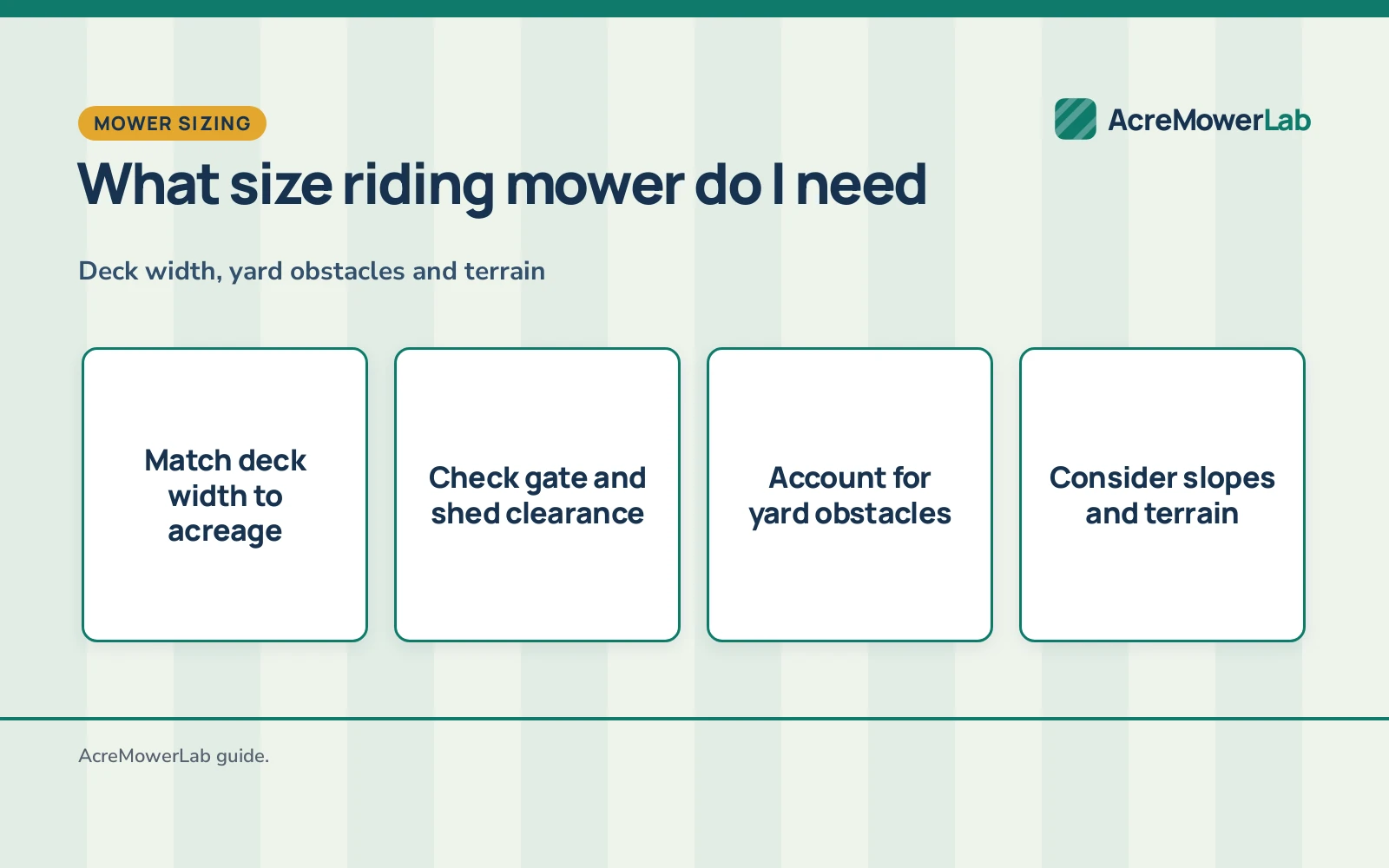
To answer what size riding mower do I need, match cutting deck width to your acreage while ensuring the machine clears narrow gates and storage entries. A compact deck maneuvers around plantings and tight gates, whereas a wide deck clears open acreage in fewer passes. This guide explains how to balance deck width, obstacles, slopes, and storage step by step.
AcreMowerLab earns a commission when you shop through links here. It never changes your price. Affiliate disclosure.
What size riding mower do I need: match deck size to acreage
| Mower type | Best for | Limit |
|---|---|---|
| Compact lawn tractor | Modest acreage, tight storage, light yard carts | Narrower cut takes more passes on acreage |
| Standard lawn tractor | Rolling acreage and general mowing | Wider turning circle than zero-turn models |
| Residential zero-turn | Open acreage with trees and garden beds | Reduced traction on steep slopes and wet turf |
| Garden tractor | Heavy acreage and ground-engaging tools | Larger storage footprint and machine weight |
Choosing deck size balances mowing pace against obstacles and storage. See our riding lawn mower sizes guide for width measurements, or check our best riding lawn tractor review for tractor picks.
For example, the Husqvarna TS 120 lawn tractor listing features a 46-inch cutting width for mid-sized residential acreage. In contrast, the Husqvarna Z254F zero-turn listing specifies a 54-inch cutting deck to cover open ground rapidly. Cutting width reflects blade path, not total machine width.
Step 2: measure gates and storage access
Before choosing deck width, measure every gate and doorway opening. Mowers cannot pass through gates that are narrower than the deck housing and discharge chute.
A mower’s total width exceeds its cutting width. While the Husqvarna TS 120 listing states a 46-inch cutting width, its published overall dimensions list a width of 54 inches, a length of 60 inches, and a height of 50 inches. You need more than 54 inches of gate clearance to pass safely without snagging the chute.
Larger decks demand wider openings. The Husqvarna Z254F listing specifies a 54-inch cutting deck, but its published dimensions show a width of 67 inches, a length of 75 inches, and a height of 40 inches. Forcing a 67-inch machine through a 60-inch gate damages equipment. Verify garage and shed floor space for parking and maintenance clearance.
Step 3: assess terrain and slope limits
Topography dictates mower style and deck choice. Zero-turn mowers excel on flat ground, but their drive wheels can lose traction on steep inclines or damp grass, reducing steering control as front caster wheels swivel freely.
Lawn tractors offer better directional control on modest slopes through mechanical front steering. Follow manufacturer slope limits to prevent tip-overs. For extreme slopes beyond rider limits, tracked remote equipment is used. The INFRONT remote control lawn mower listing claims slope climbing up to 45 degrees (noting 40 to 45 degrees in its description) on rubber tracks. Read our best riding mower for hills guide to review slope ratings.
Step 4: account for obstacles and yard layout
Yard layout determines whether a wide deck saves time. On open parcels, wide decks reduce passes. Where trees, garden beds, and corners crowd the lawn, oversized decks hinder progress.
Maneuvering wide decks around plantings requires frequent stopping and reversing. The Husqvarna TS 120 listing publishes a forward ground speed of 5 mph and a reverse speed of 2 mph. Backing up at 2 mph repeatedly around obstacles consumes more time than steady mowing with a compact deck. A nimble deck maintains continuous motion and limits string trimming. See our guide on how long does it take to mow an acre to evaluate yard layout factors.
Step 5: decide between tractor and zero-turn styles
Choose mower style based on property layout and seasonal chores.
- Lawn tractor: intuitive steering wheel, pulls trailers or aerators, and tracks stably across rolling acreage. See our best riding mower for 1 acre guide for tractor picks.
- Zero-turn mower: dual steering levers, turns on the spot, and shortens mowing time around obstacles. Our best zero-turn mower for 2 acres roundup compares deck choices.
- Garden tractor: heavier frames and transmissions for ground attachments across acreage.
- Commercial rider: fabricated decks and large engines for frequent, demanding acreage mowing.
Mowers for open turf lean toward zero-turn agility, while property owners pulling yard carts or spreaders benefit from tractors with hitch capability.
Plan your property in zones
Dividing acreage into zones clarifies mower size needs across varied ground.
A home lawn zone concentrates plantings, walks, and beds requiring nimble navigation. Outer field zones allow long, uninterrupted passes where a 54-inch deck, such as on the Husqvarna Z254F listing, clears acreage rapidly. Rough boundary zones with fence lines and ditches are then finished with trimmers or walk mowers.
Match engine power to deck workload
Wider decks require larger engines to spin multiple blades and discharge thick clippings without bogging down in damp or tall grass.
The Husqvarna TS 120 listing pairs a 22HP engine with a 46-inch stamped 2-blade deck and a 2.5 gallon fuel tank. The wider Husqvarna Z254F zero-turn listing utilizes a 24HP 726cc engine to drive its 54-inch fabricated deck. For compact equipment, the INFRONT remote mower listing uses a 9HP 225CC engine for its 19.68-inch cutting width. Verify engine output matches deck width and turf density.
Adjust cutting height and deck settings
Deck height adjustability prevents scalping on undulating turf and accommodates seasonal grass growth.
The Husqvarna Z254F listing specifies 6 cutting height positions with a published minimum adjustable cutting height of 1 inches. The INFRONT remote mower listing provides cutting height adjustment from 0.79 to 5.9 inches for brush. Choose a mower providing settings suited to your grass variety.
Mind ground moisture and turf conditions
Ground moisture affects machine traction. Expanding deck widths and frame sizes increase weight, affecting soil compaction.
Heavy riders leave rut marks in soggy ground. The Husqvarna Z254F listing publishes a weight of 595 pounds with 11-inch wheels, requiring firm soil. By contrast, the tracked INFRONT listing states a weight of 374 pounds across rubber tracks. Select equipment weight your soil can support without rutting.
Safety
Never exceed manufacturer slope limits. Zero-turn mowers risk losing traction on steep slopes, near ditches, or retention ponds, causing sliding.
Use rollover protective structures and seat belts where equipped. Never carry passengers. Keep children and pets away from mowing areas. Disengage blades before shifting into reverse. Shut down and cool engines before fueling. Wear protective eyewear, sturdy boots, and hearing protection.
FAQ: mowing large lots
What size riding mower do I need for my property?
Match deck width to acreage, obstacles, and storage. A 46-inch deck on the Husqvarna TS 120 listing suits mid-sized acreage, while a 54-inch deck on the Husqvarna Z254F listing accelerates open mowing.
Can a 54-inch riding mower fit through standard yard gates?
Rarely. A 54-inch deck, such as on the Husqvarna Z254F listing, has an overall width of 67 inches with the discharge chute, requiring wide gate clearance.
How do slopes affect riding mower size choice?
Riders have strict slope limits on hills. Tracked equipment, such as the INFRONT listing claiming slope climbing up to 45 degrees, handles steep grades.
Is a zero-turn faster than a lawn tractor of the same deck width?
Yes, zero-turns pivot on the spot around obstacles, while lawn tractors require repositioning but excel at towing attachments across rolling terrain.
What size riding mower deck is too large for an obstacle-filled yard?
A deck is too large if you constantly stop and reverse around trees and beds. Compact decks maintain forward motion to finish faster.
More mowing guides
- Riding Lawn Mower Sizes: Deck Width, Dimensions and Storage Guide
- Best Riding Mower for 1 Acre: 4 Picks by Deck Size
- Best Zero-Turn Mower for 2 Acres: 3 Picks by Deck Size
- Best Riding Mower for Hills: 4 Picks and How to Read Slope Ratings
Explore our riding mower reviews to compare mower categories, deck widths, and specifications for your property.