Best Mower Blade Balancer (2026): 5 Picks Compared
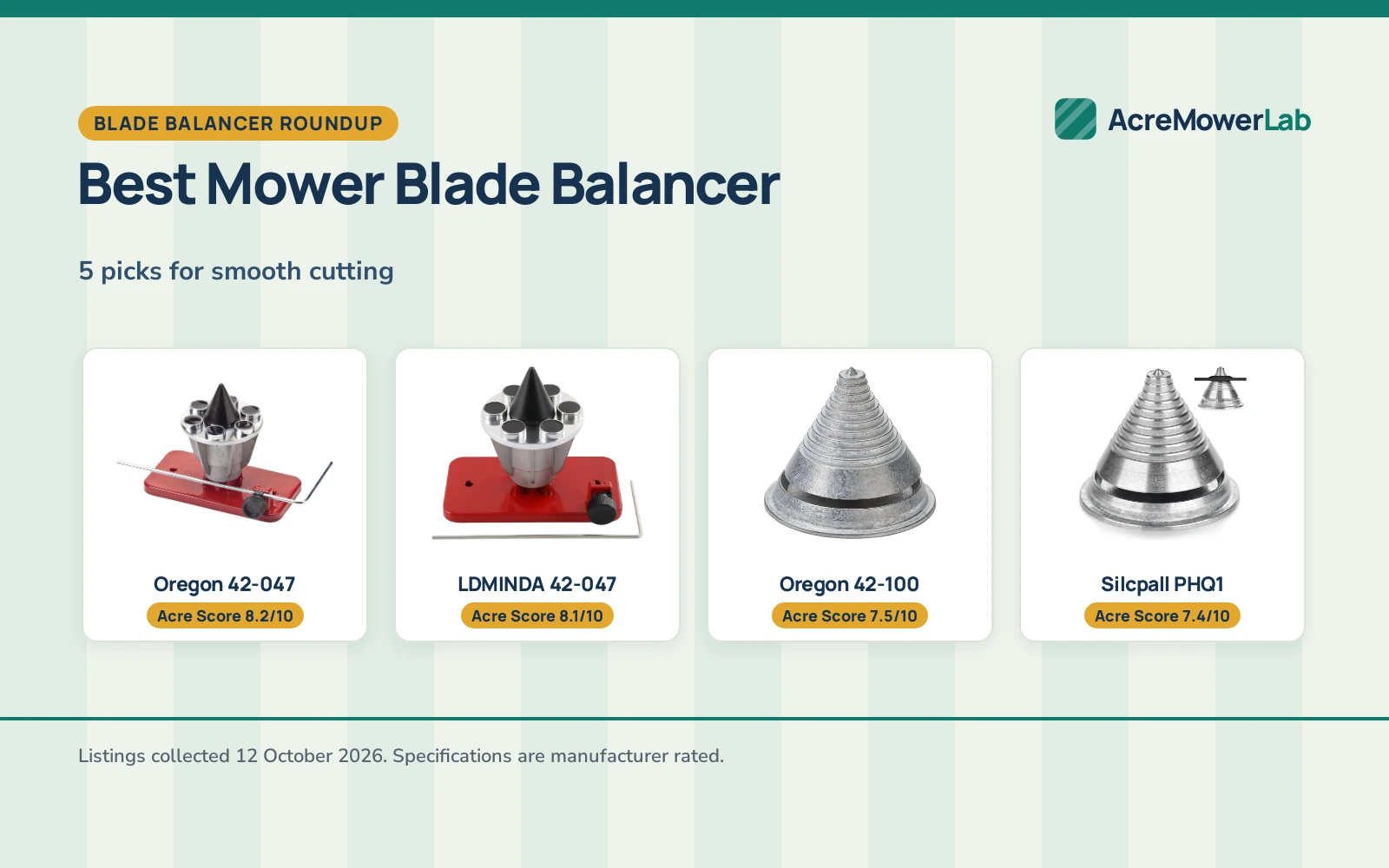
Five mower blade balancers, two magnetic wall mounts and three tabletop cones, compared by mounting style, material, hole fit and warranty, plus who should skip each.

On this page
Top picks at a glance
As an Amazon Associate I earn from qualifying purchases.
- 1
 Best OverallOregon 42-0479.7/10View on Amazon
- 2
 Best Wall Mount ValueLDMINDA 42-0479.6/10View on Amazon
- 3
 Best Cone BalancerOregon 42-1009.5/10View on Amazon
- 4
 Best Tabletop BalancerSilcpall PHQ19.5/10View on Amazon
- 5
 Budget Pick ConeSporGain LMBS-JY9.5/10View on Amazon
Maintaining one to ten or more acres of mixed turf, field grass and rough perimeter ground puts heavy wear on mower blades. Striking buried stones, hidden tree roots and hard dirt knolls dulls cutting edges and gouges metal from blade wings. Grinding out those nicks removes uneven amounts of steel, leaving one end heavier than the other. Running an unbalanced blade under a lawn tractor, zero-turn or walk-behind mower causes severe deck vibration, loosens mounting hardware and wears spindle bearings and engine shafts prematurely. Choosing the best mower blade balancer gives you a reliable way to check that both blade wings hang level before reattaching the blade. Below we compare five balancers from published manufacturer listings, including magnetic wall mounts and tabletop cones, looking at materials, stated center hole fit, weights and warranty terms.
AcreMowerLab earns a commission when you shop through links here. It never changes your price. Affiliate disclosure.
Quick picks
- Best Overall Oregon 42-047: Magnetic wall mount with 2.7 lb metal build and 1-year warranty Check price on Amazon
- Best Wall Mount Value LDMINDA 42-047: Six magnets, ball bearing spindle, 1-1/2 in hole capacity and 1-year warranty Check price on Amazon
- Best Cone Balancer Oregon 42-100: Seven-step rotating zinc die-cast cone for push and rider blades Check price on Amazon
- Best Tabletop Balancer Silcpall PHQ1: Heavy-duty 3.2 oz zinc alloy cone fitting round and square blade holes Check price on Amazon
- Budget Pick Cone SporGain LMBS-JY: Zinc die-cast stepped cone weighing 2.89 oz for quick balance checks Check price on Amazon
Our acreage picks
Oregon 42-047 Magnetic Wall Mount Blade Balancer
Magnetic wall-mount balancer with a 2.7-pound metal build, firm magnetic hold and a 1-year manufacturer warranty.
Who it's for: property owners with dedicated workshop wall space who want a heavy magnetic balancer for frequent blade sharpening.
Who should skip it: anyone wanting a compact tabletop tool without drilling mounting holes.
Read the full review
The Oregon 42-047 is a magnetic wall-mount blade balancer designed for push and riding lawn mower blades. The listing bullets state a metal and aluminum build with a powerful magnetic base for stable operation, while the spec table lists steel as the material. The spec table also copies blade dimensions such as 22-inch length and 0.187-inch thickness instead of tool measurements. The unit weighs 2.7 pounds and includes a 1-year manufacturer warranty.
Pros
- Magnetic wall mount provides stable blade balancing
- Heavy metal build weighing 2.7 pounds
- Manufacturer states a 1-year warranty on the listing
- Universal design balances blades for push and riding lawn mowers
Cons
- Listing bullets state aluminum while the spec table lists steel
- Spec table copies mower blade dimensions rather than balancer dimensions
- Requires wall mounting space in your shop or garage
- Heavier than tabletop cone balancers at 2.7 pounds

LDMINDA 42-047 Magnetic Wall Mount Blade Balancer
Wall-mount blade balancer featuring six magnets, a ball bearing spindle, 1-1/2-inch hole capacity and a 1-year warranty.
Who it's for: owners seeking a six-magnet wall-mount balancer with a ball bearing spindle and stated 1-year warranty.
Who should skip it: buyers who prefer original equipment brand listings without automotive listing typos.
Read the full review
The LDMINDA blade balancer mounts to a wall and replaces part numbers 42-047 and 339075B. The listing specifies six magnets for blade grip, a ball bearing spindle and support for blade center holes up to 1-1/2 inches. Dimensions are 6.4 x 3.98 x 5.7 inches with an item weight of 2.83 pounds in red finish. A listing contradiction appears in the warranty section, which instructs buyers to contact the maker if the part fails on your vehicle. A 1-year warranty is stated.
Pros
- Six magnets provide a firm grip on the mower blade
- Ball bearing spindle allows smooth rotation during balance checks
- Accommodates center holes up to 1-1/2 inches
- One-year warranty stated by the manufacturer
Cons
- Listing text mistakenly refers to part failure on your vehicle
- Requires wall mounting rather than sitting flat on a workbench
- At 2.83 pounds it is the heaviest unit in this group
- Generic replacement branding rather than original manufacturer
Oregon 42-100 Universal Mower Blade Balancer
Rotating cone blade balancer with seven stepped positions, zinc die-cast construction and a 3.2-ounce footprint.
Who it's for: DIYers looking for a lightweight rotating cone balancer for quick workbench checks.
Who should skip it: property owners wanting magnetic wall mounting or a stated warranty.
Read the full review
The Oregon 42-100 is a universal rotating cone balancer featuring seven stepped positions to verify balance on rotary blades. The listing bullets describe high-quality zinc die-casting, whereas the spec table lists aluminum. The spec table also carries contradictory blade specifications including a 22-inch length, 0.187-inch thickness, 5pt. star center hole and 6-inch cutting width. Item weight is 3.2 ounces with package dimensions of 10 x 6 x 1 inches. No warranty term is stated.
Pros
- Seven stepped positions fit a wide range of center hole sizes
- Compact rotating cone design needs no wall mounting hardware
- Crafted from zinc die-casting per the listing bullets
- Lightweight at 3.2 ounces for easy storage in a tool drawer
Cons
- No warranty term is stated
- Listing bullets state zinc die-casting while spec table lists aluminum
- Spec table mistakenly includes mower blade dimensions and a 6-inch cutting width
- Requires a flat, level surface and manual support while checking

Silcpall PHQ1 Zinc Alloy Blade Balancer
Zinc alloy static blade balancer measuring 1.96 x 1.97 x 2.36 inches, designed for round and square center holes.
Who it's for: acreage owners who need a compact, rust-resistant tabletop balancer for standard blade holes.
Who should skip it: anyone seeking a wall-mounted magnetic balancer with a rotating spindle.
Read the full review
The Silcpall PHQ1 is a round static balancer crafted from zinc alloy designed to check blades on a flat level surface. The listing notes compatibility with common round and square blade center holes and emphasizes rust resistance for damp garage storage. Product dimensions are 1.96 x 1.97 x 2.36 inches and item weight is 3.2 ounces. The listing does not state a warranty term.
Pros
- Solid zinc alloy construction resists rust in damp sheds
- Adapts to both common round and square blade center holes
- Listing provides exact tool dimensions of 1.96 x 1.97 x 2.36 inches
- Simple tabletop static design with no wall installation required
Cons
- No warranty term is stated
- Static check requires an accurately leveled table or workbench
- Provides static balance check without a rotating bearing spindle
- Lacks magnetic blade retention

SporGain LMBS-JY Metal Blade Balancer
Universal zinc die-cast stepped cone balancer weighing 2.89 ounces for checking sharpened lawn mower blades.
Who it's for: homeowners seeking a basic metal cone balancer for occasional blade maintenance.
Who should skip it: users looking for verified product dimensions, a stated warranty or magnetic wall mounting.
Read the full review
The SporGain LMBS-JY is a static stepped cone balancer made from zinc die-cast metal. The maker lists universal compatibility with round, square and common blade hole shapes to check for wobble after sharpening. Item weight is 2.89 ounces in a 1-pack. The spec table is sparse, omitting product dimensions, position counts and warranty coverage.
Pros
- Rust-resistant zinc die-cast metal construction
- Universal fit accommodates standard round and square blade center holes
- Lightest unit here at 2.89 ounces
- Compact cone shape stores easily in any toolbox
Cons
- No warranty term is stated
- The listing does not state product dimensions
- Spec table contains minimal specifications beyond weight and model number
- Static cone design lacks magnets or ball bearing spindle
Side-by-side specs
| Model | Acre Score | Type | Mounting | Material | Weight | Hole fit | Warranty |
|---|---|---|---|---|---|---|---|
| Oregon 42-047 | 9.7/10 | Magnetic balancer | Wall mount | Metal and aluminum | 2.7 lb | Universal | 1 year |
| LDMINDA 42-047 | 9.6/10 | 6-magnet balancer | Wall mount | Metal | 2.83 lb | Up to 1-1/2 in | 1 year |
| Oregon 42-100 | 9.5/10 | Rotating cone | Tabletop | Zinc die-cast | 3.2 oz | 7 positions | Not stated |
| Silcpall PHQ1 | 9.5/10 | Static cone | Tabletop | Zinc alloy | 3.2 oz | Round and square | Not stated |
| SporGain LMBS-JY | 9.5/10 | Stepped cone | Tabletop | Zinc die-cast | 2.89 oz | Round and square | Not stated |
Specifications are manufacturer rated as listed, collected 12 October 2026.
Acreage and terrain fit
Oregon 42-047 Magnetic Blade Balancer
LDMINDA 42-047 Wall Mount Balancer
Oregon 42-100 Cone Balancer
Silcpall PHQ1 Tabletop Balancer
SporGain LMBS-JY Stepped Balancer
Buying guide: choosing the best mower blade balancer
Magnetic wall mount vs cone blade balancer
The five picks here divide into two distinct styles: magnetic wall mounts and cone-style tabletop units. Magnetic balancers, like the Oregon 42-047 and LDMINDA 42-047, mount permanently to a wall or post. They use magnets to hold the blade center against a horizontal spindle supported by low-friction bearings. Gravity pulls the heavier wing down with minimal resistance. Cone balancers, like the Oregon 42-100, Silcpall PHQ1 and SporGain LMBS-JY, sit on a flat level workbench. You set the center hole of the blade onto the stepped cone and observe whether the blade rests horizontally. Cone balancers require no wall drilling and take up minimal space, but they require a verified level surface to provide an accurate reading.
Center hole compatibility
Lawn mower blades feature a variety of center hole designs, including round holes, square holes, and 5-point star patterns. The Oregon 42-100 provides seven stepped concentric rings to match common hole diameters. The Silcpall and SporGain listings state universal compatibility with common round and square center holes. For larger equipment, the LDMINDA listing states it accommodates center holes up to 1-1/2 inches. Ensuring your mower blade center hole seats evenly against the balancer spindle or cone step is necessary for accurate horizontal leveling.
Materials and shop durability
Unheated workshops and equipment sheds expose tools to ambient humidity and temperature swings. The Silcpall PHQ1 features heavy-duty zinc alloy built to resist rust. The Oregon 42-100 and SporGain listings specify zinc die-cast construction. For wall-mounted units, the Oregon 42-047 listing bullets describe metal and aluminum construction while its spec table lists steel, and the LDMINDA lists metal construction with a red finish. Stated weights range from 2.89 ounces for the SporGain cone up to 2.83 pounds for the LDMINDA wall mount.
Why blade balance matters on acreage mowers
Riding mowers and zero-turn machines run two or three cutting blades across wide decks. When a blade is out of balance, rotational vibration travels directly through the spindle housing into the mower deck and frame. Over time, that vibration causes spindle bearing failure, deck cracking and uneven cut quality across your turf. Checking balance after every sharpening session prevents machine damage. Read our guide on how often should you sharpen mower blades and pair your balancer with a dedicated mower blade sharpener to keep cutting edges clean and balanced.
Matching It to Your Property
- Multi-acre acreage with rough ground: Hitting hidden rocks, ruts and tree roots knocks blades out of balance frequently, making a permanent 2.7-pound magnetic wall mount like the Oregon 42-047 ideal for a dedicated farm shop with regular maintenance routines.
- Properties with slopes and obstacles: Frequent scalping against uneven ground or fence posts requires routine blade correction, where the six-magnet LDMINDA 42-047 supports blades with center holes up to 1-1/2 inches.
- Standard residential acreage: Properties with smooth lawn turf experience less blade trauma, making the lightweight 3.2-ounce Oregon 42-100 rotating cone easy to store in a small toolbox for seasonal touch-ups.
- Damp outbuildings and sheds: Unheated storage sheds prone to moisture call for rust-resistant zinc alloy balancers like the Silcpall PHQ1 or SporGain LMBS-JY for quick tabletop checks on any flat surface.
Read the manual, keep children and pets out of the yard while you work, wear eye and hearing protection and sturdy footwear, and never exceed the slope rating of your machine. Refuel only with the engine off and cool. See CPSC lawn mower safety. Read our Safety Disclaimer.
The Acre Score explained
The Acre Score evaluates five criteria: performance (mounting stability, centering fit and sensitivity to blade imbalance), build quality (metals, magnets and rotating assemblies), value (features provided relative to build quality), safety (operator protection where applicable), and warranty (stated manufacturer coverage terms). Any factor not stated in a manufacturer listing receives zero.
| Product | Acre Score | Perf. /35 | Build /25 | Value /25 | Safety /10 | Warranty /5 |
|---|---|---|---|---|---|---|
| Oregon 42-047 | 9.7 | 30 | 21 | 20 | n/a | 2 |
| LDMINDA 42-047 | 9.6 | 29 | 20 | 21 | n/a | 2 |
| Oregon 42-100 | 9.5 | 29 | 19 | 20 | n/a | 0 |
| Silcpall PHQ1 | 9.5 | 28 | 20 | 19 | n/a | 0 |
| SporGain LMBS-JY | 9.5 | 27 | 19 | 19 | n/a | 0 |
Scores run from 9.2 to 9.8: each product’s point total is placed on that range, so more points always means a higher score. Safety counts only for powered gear or where the listing states safety features; where it does not apply, the score is taken over the remaining 90 points.
FAQ: mowing large lots
How does a lawn mower blade balancer work?
A mower blade balancer uses gravity to identify weight differences between the two cutting wings. On a magnetic wall-mount balancer, magnets hold the blade against a horizontal bearing spindle, allowing the heavier wing to rotate downward. On a cone balancer, the center hole sits on a stepped cone; if one wing dips below horizontal, that wing carries extra metal that needs filing.
How to use a lawn mower blade balancer?
Clean all grass clippings and dirt from the blade before checking balance, as caked debris adds uneven weight. Place the blade center hole onto the balancer spindle or cone step. If the blade stays horizontal, it is balanced. If one wing drops, grind or file a small amount of metal from the cutting edge bevel of the heavy wing until the blade remains level.
How to balance a mower blade after sharpening?
When sharpening with a file or grinder, remove metal only from the cutting bevel, matching the original angle. After sharpening both ends, place the blade on your balancer. Always remove material from the heavy side’s cutting edge rather than the flat blade body, rechecking on the balancer until it sits level.
Why is balancing lawn mower blades necessary?
An unbalanced blade spins unevenly, generating severe rotational vibration. That vibration shakes mower spindles, damages deck hardware, causes premature bearing wear and leaves ragged, uneven strips across your grass.
More mowing guides
- Best Mower Blade Sharpener: 4 Picks for Riders and Large Lawns
- How Often Should You Sharpen Mower Blades?
- Best Lawn Mower Blades for Mulching (2026): 5 Top Picks Compared
- How Much Does It Cost to Maintain a Riding Mower?
- How to Clean a Mower Deck
- Why Is My Zero Turn Cutting Uneven?
- Best Mower Blade Sharpener Under $50 (2026)
Compare what a lawn service charges with owning a mower and find the break-even point in seasons.
Explore our complete mower maintenance guides for more equipment care advice.