Why Is My Zero Turn Cutting Uneven?
A step-by-step troubleshooting guide to fix an uneven zero-turn cut by checking tire pressure, leveling the deck, and inspecting blades.

On this page
Top picks at a glance
As an Amazon Associate I earn from qualifying purchases.
- 1
 SEATIN Comfortable Zero Turn Mower Seat9.7/10View on Amazon
- 2
 EGO Power+ Z6 Zero Turn Electric Riding Lawn Mower9.6/10View on Amazon
- 3
 Greenworks 60V 54" MaximusZ Zero Turn Mower9.6/10View on Amazon
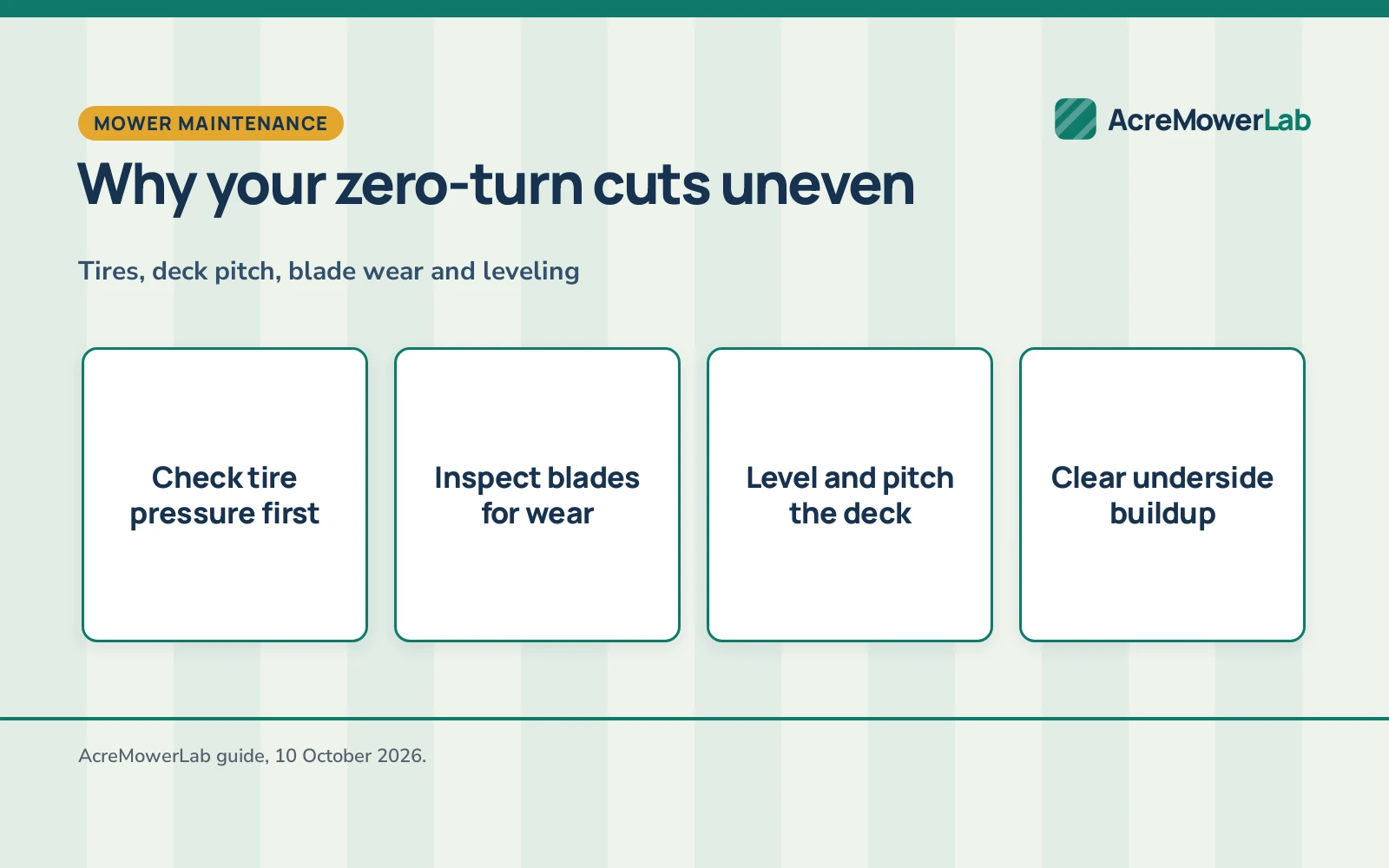
If you are wondering why is my zero turn cutting uneven, the primary causes include unequal rear tire pressure, an unlevel cutter deck, worn or damaged blades, and compacted grass clippings underneath the deck. Because a zero-turn mower deck is suspended beneath the chassis, any difference in tire inflation immediately tilts the deck toward the lower side, producing a stepped cut across your turf. Leveling the deck, equalizing tire pressure per your operator manual, and maintaining sharp, balanced blades will quickly restore a clean, flat cut across your acreage.
AcreMowerLab earns a commission when you shop through links here. It never changes your price. Affiliate disclosure.
Why is my zero turn cutting uneven: start with the deck and tires
| Uneven cut cause | Observed cut pattern | Recommended correction |
|---|---|---|
| Unequal drive tire pressure | Stepped cut lower on one side across consecutive passes | Inflate rear drive tires to match manual specification |
| Misaligned side-to-side deck hangers | Consistent slope across swath regardless of tire pressure | Adjust lift linkage nuts until left and right blade tips match |
| Improper front-to-rear deck pitch | Uncut grass stragglers, poor discharge, or increased blade drag | Adjust front hanger bracket to match manual pitch specification |
| Worn, dull, or bent blades | Streaks of uncut grass and ragged, brownish turf tips | Sharpen dull cutting edges or replace bent blades |
| Compacted debris under deck | Uneven grass discharge, clumping, and reduced suction lift | Scrape grass buildup from the underside of the cutter deck |
A smooth cut requires balanced machine geometry from the turf up. If you are shopping for a new machine or comparing deck sizes for your property, read our guide on the best riding mower for 1 acre to compare cutting deck widths and power configurations.
Step 2: inspect and balance mower blades
Bent, dull, or improperly installed blades are a frequent cause of stepped and streaked lawns. Remove the ignition key and disconnect the spark plug wire before inspecting blades. Look closely at the blade tips: if an edge struck a rock or tree root, the blade can bend upward or downward. A bent blade sweeps a different plane of rotation than adjacent blades, leaving an uncut strip or high ridge on every pass.
Dull cutting edges tear grass blades instead of slicing them cleanly, causing the lawn tips to brown and look ragged. For sharpening schedules and maintenance advice, see our guide on how often should you sharpen mower blades. When you sharpen blades, balance them on a blade cone or nail before reinstalling. An unbalanced blade causes severe deck vibration that loosens mounting hardware over time. Having an extra set of blades on hand minimizes downtime during peak mowing season; explore our best mower blade sharpener recommendations for bench and garage tools.
Multiple-blade cutter decks require every blade to rotate on an identical plane. For example, Reliable Aftermarket Parts lists replacement blades for Ferris zero-turn decks configured with 2 blades on a 36 inch deck and 3 blades on a 52 inch deck. On multi-blade decks, always verify that all blades are identical in length, thickness, and lift profile. Mixing worn blades with new blades causes an uneven cut across the deck swath.
Step 3: level the deck side to side
Side-to-side deck leveling ensures both sides of the mower cut at the exact same height from the ground. Before making any mechanical adjustments to your deck hangers, verify tire pressure on both rear drive tires per manual specifications, as well as front caster tires if pneumatic. Attempting to level a mower deck with uneven tire pressure will throw the deck out of alignment as soon as the tires are inflated.
Park the machine on flat, level concrete. Rotate the outer blades so the cutting tips point directly outward toward the deck sides. Measure the distance from the outside blade tip to the concrete floor on the left side, then repeat the measurement on the right side. Do not measure from the deck shell, as stamped or fabricated deck rims may have minor imperfections. If the two measurements differ, locate the deck adjustment linkage nuts on the lift arms. Loosen the jam nuts and turn the adjustment nuts to raise or lower the low side until both blade tips match within manual tolerance. Proper deck leveling procedures apply across zero-turn platforms as well as conventional tractors in our riding mowers section.
Step 4: set front to rear deck pitch
Front-to-rear deck pitch, often called deck rake, determines how grass clippings flow through the cutting chamber. Most zero-turn manufacturers recommend a slight forward pitch, though some manuals specify a level deck. When a deck slopes backward, however, the rear edge of the blade cuts the grass a second time, robbing engine power and tearing grass blades into ragged tatters.
To check deck pitch, rotate one center or outer blade so the cutting tips point straight forward and straight backward. Measure from the front blade tip to the hard floor, then measure from the rear blade tip to the floor. Consult your operator manual for the exact pitch setting: many models specify that the front blade tip sit slightly lower than the rear blade tip, while others specify level alignment. If adjustment is required, loosen the front deck hanger bracket nuts and adjust the front draft rod until the blade tips achieve the specified rake. Tighten all lock nuts firmly once the correct pitch is established.
Step 5: clear deck underside and inspect spindles
Wet grass clippings, mud, and organic mulch pack tightly against the underside of the cutter deck. Over time, this buildup forms dense crusts around the baffles and discharge chute. This buildup disrupts the vacuum airflow necessary to lift grass blades upright before they contact the cutting edge. Without sufficient suction, bent grass stems spring back up after the mower passes, leaving an uneven, ragged appearance.
Scrape the underside of the deck clean after mowing wet turf or heavy growth. For proper deck cleaning procedures, review our guide on how to clean a mower deck. While working under the deck, check each blade spindle. Grasp each blade tip wearing heavy work gloves and attempt to move the spindle shaft vertically and side to side. Any noticeable play, clicking, or rough grinding indicates worn spindle bearings that allow the blade to wobble at high speeds. If hardware replacement is required, see our zero turn mower parts guide for maintenance components.
Park on a flat, level surface
Accurate deck leveling requires a hard, flat reference surface. Grass turf deflects beneath tire tread unevenly, making consistent blade height measurements impossible on a lawn, packed gravel, or an uneven driveway. A flat concrete slab or garage floor provides the necessary baseline for every deck and tire check.
When positioning the mower, ensure the parking brake is firmly engaged and the front caster wheels point straight forward. If caster wheels are turned sideways, the front axle sits at an altered height, skewing blade measurements. Some operators use a digital angle gauge such as the Klein Tools digital gauge, which measures across 0-90 degree ranges, to check floor slope and confirm that measuring surfaces provide a true reference plane.
Inspect deck belt and tensioner pulleys
A slipping cutter deck belt prevents blades from maintaining full cutting speed when contacting dense turf. When blade tip speed drops, blades push grass down rather than cutting through it crisply, causing ragged patches and uneven swathes on your lawn.
Inspect the cutter deck drive belt for cracking, frayed edges, dry rot, or glazing along the contact ribs. For example, C-YONG lists a replacement 48 inch cutter deck belt for Spartan zero-turn mowers. Ensure that the deck idler arm pivots smoothly on its bushing and that the belt tension spring retains firm tension. A sticking idler arm fails to take up belt slack, leading to blade bogging in thick turf.
Check mower ground speed and overlap passes
Zero-turn mowers are capable of rapid travel speeds, but cutting thick grass at maximum forward velocity frequently produces an uneven cut. When forward ground speed exceeds the ability of the blades to cut and clear clippings, uncut strands slip beneath the deck baffles.
Slow your forward ground speed in overgrown or dense sections of your acreage to allow the blades to process grass efficiently. Additionally, maintain adequate overlap between passes. Zero-turn mowers have wide drive wheelbases, and failing to overlap passes slightly can leave narrow strips of uncut grass between tire tracks, particularly along undulating terrain.
Mind ground conditions and tire traction
Ground contours and surface moisture directly impact cut quality. When one drive tire encounters soft, spongy soil or a depression in the turf, the machine dips on that side, driving the cutter deck closer to the soil and scalping the lawn.
Avoid mowing when turf is wet or waterlogged. Moist grass mats down under tire tread before reaching the cutting deck, and wet clippings quickly clog the discharge opening. Furthermore, zero-turn drive tires can spin and slip on damp turf, tearing grass roots and throwing the deck off balance during sharp maneuvers.
Safety
Safety is paramount when operating and maintaining riding equipment. Disengage mower blades, engage the parking brake, shut off the engine, and remove the ignition key before performing any deck inspection, blade service, or cleaning underneath the cutter deck. Disconnect the spark plug wire or remove the main battery disconnect to prevent accidental engine startup.
Wear heavy leather gloves when handling mower blades, along with proper eye and hearing protection. Clear sticks, stones, wire, and hidden debris from the yard before mowing, and keep children, bystanders, and pets completely out of the mowing area. Never carry passengers under any circumstances. On zero-turn mowers, always keep the rollover protective structure upright and latch your seat belt where equipped. Zero-turn mowers steer through rear drive wheels and can lose steering control and traction on slopes or near ponds and ditches. Never exceed the maker maximum slope rating, and disengage blades before reversing. Refuel only with the engine completely shut off and cool. To learn more about operating safely on inclines, see our guide on whether are zero turn mowers safe on hills.
FAQ: mowing large lots
How do I know if my zero turn deck is unlevel?
An unlevel deck typically leaves a stepped or ridged cut across the lawn, where one side of every mowing pass is noticeably shorter than the other. You can verify this by parking on flat concrete and measuring from the cutting edge of each blade tip to the ground.
Why is my mower cutting lower on one side?
The most common cause is unequal tire pressure between the rear drive wheels. A tire with lower inflation drops that side of the machine, causing the deck to cut closer to the turf. If tire pressure matches on both sides, check for bent deck lift linkages or loose adjustment hardware.
Should mower deck pitch be lower in the front or rear?
On most zero-turn models, the front blade tip should sit slightly lower than the rear blade tip, though some manuals specify a level deck. This forward pitch ensures the front edge cuts the grass once cleanly, allowing clippings to discharge freely without the rear blade edge re-cutting and tearing the turf. Always check your model operator manual.
Can worn mower blades cause an uneven cut?
Yes. Dull cutting edges tear grass rather than slicing it, producing ragged edges and streaking. A blade bent from striking an obstruction will rotate on a lower or higher plane than adjacent blades, leaving uneven swaths across your lawn.
How often should I check zero turn deck leveling?
Check deck level at the start of each spring mowing season, after hitting a solid obstacle like a stump or curb, and whenever you notice uneven mowing patterns on your lawn. Always verify tire pressure before adjusting deck linkages.
More mowing guides
- Best Riding Mower for 1 Acre: 4 Picks by Deck Size
- Best Zero-Turn Mower for 2 Acres: 3 Picks by Deck Size
- How to Clean a Mower Deck
- How Often Should You Sharpen Mower Blades?
Explore our zero-turn mowers hub to compare machine specifications, deck widths, and maintenance guides for your acreage.