Best Type of Mower Blades (2026)
A practical guide to choosing mower blades for acreage: compare high-lift, mulching and standard profiles for clean cutting, bagging and healthy turf.

On this page
Top picks at a glance
As an Amazon Associate I earn from qualifying purchases.
- 1
 GICOOL GY20850 42 in Mulching Blades for John Deere9.5/10View on Amazon
- 2
 116-6358-03 Mower Blades Replacement for Toro TimeMaster 309.4/10View on Amazon
- 3
 Grasscool 42 in 3-in-1 Mulching Blades for Craftsman9.3/10View on Amazon
- 4
 GICOOL 91-626 Blades for Scag Ferris Bad Boy 61" ZTR MowersView on Amazon
- 5
 GICOOL 942-0741A 21 Inch Mower Mulching Blades for Troy BiltView on Amazon
- 6
 EGO POWER+ 21" Mulching Blades for Electric Lawn MowersView on Amazon
- 7
 532138971 Mower Blades for Craftsman/HU/Pou LAN 42" LawnView on Amazon
- 8
 3 Pack 532180054 Lawn Mower Blades with 532193003 BoltsView on Amazon
- 9
 Hipa 532405380 46 Inch Mower Blades Replace for 405380View on Amazon
- 10
 532187256 54 Inch Lawn Mower Mulching BladesView on Amazon
- 11
 138971 42 Inch Lawn Mower Mulching BladesView on Amazon
Maintaining several acres of open turf demands the right cutting setup. The best type of mower blades depends on your mowing goal: high-lift blades excel at bagging and clearing tall grass, 3-in-1 mulching blades chop clippings finely to recycle nutrients, and standard medium-lift blades handle routine side discharge. Choosing the right profile prevents clumping, protects runtime, and produces an even cut across rough property.
Other machines to compare
 GICOOL 91-626 Blades for Scag Ferris Bad Boy 61" ZTR MowersCheck price on Amazon
 GICOOL 942-0741A 21 Inch Mower Mulching Blades for Troy BiltCheck price on Amazon
 EGO POWER+ 21" Mulching Blades for Electric Lawn MowersCheck price on Amazon
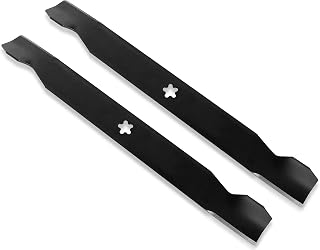 532138971 Mower Blades for Craftsman/HU/Pou LAN 42" LawnCheck price on Amazon
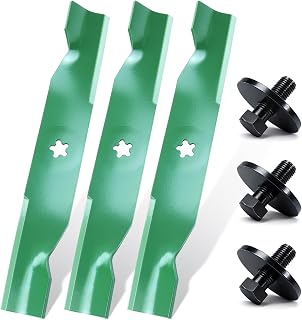 3 Pack 532180054 Lawn Mower Blades with 532193003 BoltsCheck price on Amazon
 Hipa 532405380 46 Inch Mower Blades Replace for 405380Check price on Amazon
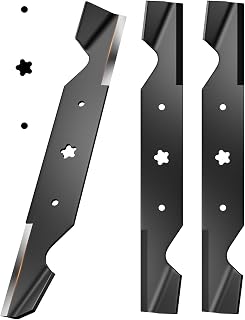 532187256 54 Inch Lawn Mower Mulching BladesCheck price on Amazon
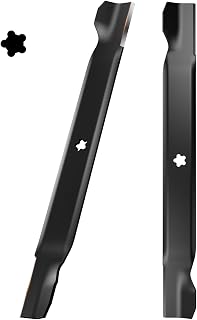 138971 42 Inch Lawn Mower Mulching BladesCheck price on Amazon
AcreMowerLab earns a commission when you shop through links here. It never changes your price. Affiliate disclosure.
Best type of mower blades: match the blade to your mowing goal
| Blade type | Best for | Drawback |
|---|---|---|
| High-lift blade | Bagging clippings, tall grass, clean discharge | Demands more power, pulls dust in loose soil |
| Mulching blade (3-in-1) | Recutting clippings into fine mulch, turf nutrients | Can clump in overgrown grass, slower travel needed |
| Standard medium-lift blade | Routine side discharge, everyday mowing | Less suction for collection, larger clippings |
| Low-lift blade | Sandy ground, dry dusty terrain | Poor lift for wet turf, ineffective for bagging |
See our best lawn mower blades for mulching guide, or visit our best lawn mower blade for bagging guide if you collect clippings.
Step 2: verify deck size and blade length
Every mower deck requires a specific diagonal blade length to prevent striking the housing or leaving uncut strips.
Walk-behind decks use a single blade: Greenworks 21-inch replacement blades list 20.08 inches long, GICOOL 21-inch blades measure 20-30/32 inches, and MaxPower blades for Toro 22-inch Recyclers measure 21-11/16 inches. Genuine EGO Power+ 21-inch electric lawn mower blades (model AB2100) fit 21-inch decks. Confirm diagonal length if replacing a lawn mower blade for Craftsman 22 inch models or an Ozito lawn mower PLM-125 blade 450mm long.
Riding decks stagger blades: Cub Cadet 46-inch decks use 23-1/4-inch blades from GICOOL, Husqvarna and Craftsman 54-inch decks use a 3-blade set of 18-1/2-inch blades from UDC Parts and MaxPower, and 61-inch zero-turns run 21-inch blades, often sold in 6-blade packs by GICOOL.
Step 3: check center hole shape and spindle fit
The center hole must match your spindle pattern exactly:
- 5-point star: Husqvarna, Craftsman, and Poulan 54-inch decks (UDC Parts and MaxPower).
- 6-point star: Cub Cadet and MTD 46-inch decks (GICOOL).
- Bow tie: Troy-Bilt and MTD 21-inch walk-behind mowers (Grasscool and GICOOL).
- Round center hole: Commercial Scag and Ferris 61-inch decks (5/8-inch center hole diameter) or Toro recyclers (7/16-inch center hole diameter).
- Shaft adapters: Some direct-drive mowers use a lawn mower blade adapter 1 inch shaft assembly.
Step 4: select steel grade and blade thickness
GICOOL and Grasscool list 9/64 inch (3.4mm to 3.5mm) thickness on residential mulching blades, while commercial high-lift blades from GICOOL for 61-inch zero-turns feature 13/64 inch (5mm) thickness to resist bending. GICOOL specifies 40MnB steel for impact toughness, while Greenworks lists alloy steel and stainless steel blades. Factory-sharpened blades arrive with a painted safety coating that protects hands during installation and wears off naturally during initial cutting.
Step 5: match blade weight to gas or electric power
Electric lawn mower blades must remain lightweight to protect battery runtime across Kobalt 40V, Greenworks 40V, 60V, 80V, and 24V, and EGO 56V platforms. Genuine EGO Power+ 21-inch steel blades (model AB2100) and Greenworks 21-inch blades list an item weight of 16 ounces. Sticking to manufacturer profiles on a lawn mower blade for Kobalt 40v or Greenworks deck prevents excessive battery draw. Gas engines easily spin heavier steel: GICOOL lists 1.75 pounds for a walk-behind blade, MaxPower lists 1.96 pounds for its 22-inch blade, and a 6-blade commercial pack for a 61-inch zero-turn lists 16.55 pounds.
Understanding high-lift blades
High-lift blades feature curved rear sails that generate upward airflow. Vertical lift heights vary: GICOOL 61-inch blades feature a 1-inch lift, GICOOL 46-inch blades feature 1-1/4 inches, and UDC Parts 54-inch blades feature 1-3/8 inches. This suction pulls grass upright for clean cuts and propels clippings into bags, but pulls abrasive grit on sandy soil.
How mulching and 3-in-1 blades work
Mulching blades, or 3-in-1 blades, feature curved edges that circulate clippings inside deck baffles to recut them finely. GICOOL 21-inch mulching blades feature a 6-3/16-inch cutting edge with a 26/32-inch air lift, while Grasscool 21-inch blades feature a 1-1/8-inch lift. Grasscool notes that recutting clippings recycles nutrients and increases bagging capacity by 50% through compaction. See our guide on whether is a mulching kit worth it.
Low-lift and standard blades for sandy ground
Standard medium-lift blades provide balanced airflow for routine side discharge. Low-lift blades feature flatter profiles with minimal wing rise, making them ideal for southern pastures and sandy ground. Producing minimal suction, low-lift blades leave abrasive grit in the soil, reducing deck wear and preventing front blowout.
What about new type of lawn mower blades?
Manufacturers regularly release new type of lawn mower blades to improve efficiency, including stacked dual-blade setups that slice grass with a lower edge and shred it with an upper blade. Other modern replacements employ wear-resistant 40MnB steel for longevity. When evaluating any new type of lawn mower blades, verify that spindle pattern, center hole diameter, and deck clearance match your machine.
Safety and blade maintenance
Disconnect the spark plug wire on gas engines or remove the battery on electric mowers before servicing blades. Wear work gloves and block the blade with wood to loosen spindle hardware. Discard bent or cracked blades immediately. Review our picks for the best mower blade sharpener and our guide on how often should you sharpen mower blades. Check balance on a mower blade balancer after grinding, and keep deck baffles clear with our guide on how to clean a mower deck.
FAQ: mowing large lots
How to choose a lawn mower blade?
Select high-lift for bagging, 3-in-1 mulching for recycling nutrients, or medium-lift for side discharge. Verify deck cut width and diagonal blade length, match the spindle center hole pattern, and pair blade weight to your power source.
What size nut holds lawn mower blade?
Fastener dimensions vary by spindle manufacturer rather than a universal standard. Check your operator manual or check the bolt head directly with a socket before removing it. Always use manufacturer-specified replacement hardware.
How to balance lawn mower blade?
Clean the blade and place the center hole on a cone balancer. If either end dips, grind small amounts of steel from that side, following the cutting bevel or taking light passes along the flat back edge, until balanced. Never grind the curved lift sail.
How to replace riding lawn mower blades?
Park on level ground, engage the brake, and disconnect the spark plug or battery. Elevate the mower securely with ramps or a lift, or remove the deck. Wedge a wooden block against the blade, loosen the bolt counterclockwise, install the new blade with sails facing up toward the deck, and tighten to manual torque specifications. See our riding mower maintenance guide.
Can lawn mower blades shatter?
Yes. Striking rocks, pipes, or stumps at high speed can fracture steel. While alloys like 40MnB steel resist impact, severe rust, fatigue, or over-thinning can cause failure. Inspect blades after impacts and replace damaged ones immediately.
More mowing guides
- Best Lawn Mower Blades for Mulching (2026): 5 Top Picks Compared
- Best Lawn Mower Blade for Bagging (2026): 5 Picks Compared
- Best Mower Blade Sharpener: 4 Picks for Riders and Large Lawns
- How Often Should You Sharpen Mower Blades?
Explore our mower maintenance section for step-by-step equipment care guides.