Top Ten Zero Turn Mower Brands (2026)
A practical guide to the top ten zero turn mower brands for acreage and residential lawns, covering build quality, deck design, commercial frames and power options.

On this page
Top picks at a glance
As an Amazon Associate I earn from qualifying purchases.
- 1
 Husqvarna MZ619.7/10View on Amazon
- 2
 EGO Power+ Z6 Zero Turn Electric Riding Lawn Mower9.6/10View on Amazon
- 3
 EGO Power+ Z6 Zero Turn Electric Riding Lawn Mower9.6/10View on Amazon
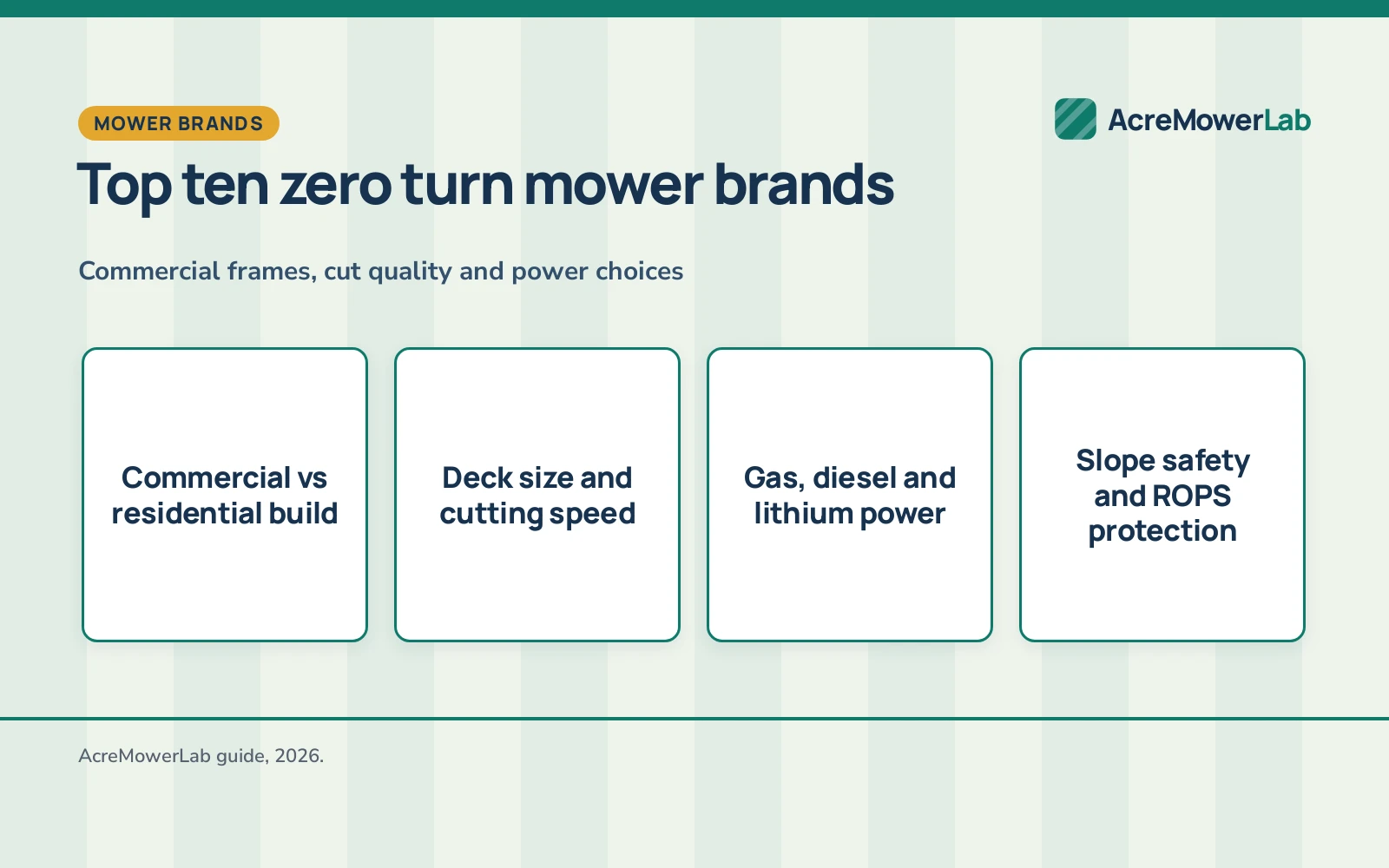
When maintaining open acreage, rough pasture edges, or yards with fence lines and scattered trees, choosing the right machine determines how many hours you spend in the seat each weekend. The top ten zero turn mower brands for acreage and residential properties are Scag, John Deere, Toro, Kubota, Gravely, Hustler, Exmark, Ferris, Bad Boy, and Cub Cadet, with electric makers like EGO Power+ providing cordless options. Professional landscapers and large acreage owners lean toward heavy commercial names such as Scag, Kubota, and Exmark for welded steel frames, while residential owners often select Toro, Cub Cadet, or John Deere for dependable yard maintenance. Choosing among these top brands comes down to matching deck construction, power source, and local dealer support to your land.
AcreMowerLab earns a commission when you shop through links here. It never changes your price. Affiliate disclosure.
Top ten zero turn mower brands: commercial and residential tiers
Zero-turn mowers fall into distinct tiers based on frame steel gauge, spindle size, transmission type, and intended weekly workload. Commercial models feature thick welded steel tubing and serviceable hydraulic pumps, whereas entry residential units use lighter stamped decks and sealed transaxles. Understanding where each brand focuses helps narrow your search before visiting a showroom.
| Brand | Primary category | Key distinction |
|---|---|---|
| Scag | Commercial | Heavy welded steel decks and high-hour durability |
| John Deere | Residential and Commercial | Widespread dealer network and versatile mower lineups |
| Toro | Residential and Commercial | Fabricated cutting decks and clean lawn finish |
| Kubota | Commercial | Diesel power options and heavy equipment engineering |
| Gravely | Commercial and Residential | Reinforced tubular frames and commercial heritage |
| Hustler | Residential and Commercial | Welded steel backbone and smooth steering controls |
| Exmark | Commercial | Commercial fleet popularity and even clipping dispersion |
| Ferris | Commercial | Independent suspension systems for rough acreage terrain |
| Bad Boy | Residential and Commercial | Heavy-gauge steel construction and aggressive frame styling |
| Cub Cadet | Residential | Accessible yard maintenance and steering wheel models |
For commercial operators managing continuous mowing schedules, explore our best commercial zero turn mower guide. Homeowners maintaining smaller acreage can review our best zero turn mower for 2 acres recommendations.
Step 2: match deck construction to property terrain
The cutting deck takes the brunt of property maintenance. Mower decks fall into two primary construction methods: stamped steel and fabricated (welded) steel. Stamped decks are pressed from a single sheet of lighter-gauge metal, producing smooth curves that promote airflow for bagging and light discharge. They work well on smooth finish turf with minimal debris.
Fabricated decks are constructed from individual plates of heavy-gauge steel welded together with reinforced leading edges and side skirts. Commercial leaders such as Scag, Gravely, and Bad Boy prioritize welded decks to withstand impacts from exposed roots, hidden rocks, and uneven pasture ground. If your property contains rough ditches or uneven surface transitions, a fabricated deck resists bending and keeps your blades level. See our breakdown on zero turn mower sizes to pick the right cutting width for your acreage and gate openings.
Step 3: compare gas, diesel and lithium battery power
Gasoline engines power the majority of residential and commercial zero-turn mowers. Twin-cylinder engines from commercial suppliers provide reliable torque for dense turf and overgrown pasture edges. For extensive rural acreage, a diesel zero turn lawn mower from commercial manufacturers like Kubota delivers high fuel efficiency, exceptional low-end torque, and long engine life under heavy daily use.
Battery technology offers an alternative for property owners seeking lower operating noise and freedom from fuel storage. A lithium battery zero turn mower eliminates oil changes, spark plugs, and fuel filters. In data listings, the EGO Power+ Z6 zero turn mower (model ZT4204L) uses a 56-volt ARC lithium battery platform. The maker lists power equivalent to a 22-horsepower gas engine, cutting up to 2 acres on a single charge with four 10.0Ah batteries. The unit features four independent brushless motors, three driving modes, mowing speeds of 3-7 MPH, and travel speeds up to 8 MPH with a 42-inch deck. For owners interested in electric equipment, read our complete EGO Z6 zero turn mower review.
Even on gas and diesel models, electrical reliability matters. Upgrading to a lithium ion battery for zero turn mower starter duty reduces weight compared to traditional lead-acid units. Listing details for Ionic Batteries show a 12-volt lithium zero turn mower battery providing 30Ah capacity, 1220 cranking amps, and 900 cold cranking amps while weighing only 9 lbs. The maker states it delivers over 3000 cycles at 80% depth of discharge and operates from -4F to 140F, with 25% capacity reserved for emergency restarts. Check our guide to the best battery for zero turn mower upgrades.
Step 4: evaluate dealer service and parts availability
A zero-turn mower is a long-term property investment that requires routine maintenance, including belt adjustments, spindle greasing, hydraulic fluid changes, and blade sharpening. Commercial brands like Scag, Exmark, and Kubota sell almost exclusively through independent outdoor power equipment dealers. These dealers assemble the machine, perform pre-delivery inspections, and stock replacement belts, pulleys, and filters.
Brands with widespread national networks, such as John Deere, Toro, and Cub Cadet, offer broad parts availability through both dedicated dealerships and regional supply stores. Before selecting a brand, evaluate which dealer is closest to your property. Having local technicians available to service hydraulic pumps or troubleshoot electrical issues reduces downtime during the peak growing season.
Step 5: inspect frame strength and roll-over protection
A rigid frame ensures that the cutting deck remains parallel to the ground, preventing uneven cuts and scalping over hummocks. Commercial machines utilize thick-walled tubular steel or channel frames welded into a single structural unit. Welded frame joints resist flexing when navigating rough fence lines or driving across washouts.
Operator protection is essential on large properties. Commercial and heavy-duty zero-turn mowers from Kubota, Exmark, Scag, Bad Boy, Husqvarna, Cub Cadet, John Deere, Gravely, Ferris, Toro, and Hustler feature standard roll-over protective structure (ROPS) tubing between 1.5 and 3 inches wide. These steel tubes provide a secure mounting point for protective accessories, including overhead shades. Reference listings indicate canopy panels measuring 44 inches wide by 44 inches long and weighing under 20 lbs mount directly to ROPS tubing between 1.5 and 3 inches wide to shield operators during long summer mowing sessions.
Handling slopes and traction on rural properties
Zero-turn mowers steer via independent hydraulic motors powering each rear drive wheel, while the front wheels caster freely. While this design provides unmatched agility around trees, flower beds, and outbuildings, it requires caution on slopes. On steep inclines, the front casters can lose directional stability, and downhill momentum can reduce rear-wheel traction.
Never operate across slopes that exceed the machine manufacturer’s maximum slope rating. Avoid operating near drainage ditches, retention ponds, retaining walls, or wet embankments where damp turf can cause tires to slide. Operators managing hilly ground should read our safety analysis on are zero turn mowers safe on hills before cutting.
Mowing speed and property productivity
One major reason property owners upgrade from standard lawn tractors to zero-turn mowers is ground speed. Standard residential zero-turns mow comfortably at steady speeds, while commercial platforms operate at higher speeds over smooth acreage. The listing for the EGO Power+ Z6 notes mowing speeds between 3-7 MPH and up to 8 MPH in travel mode. Cutting at higher speeds requires a clean cutting deck and sharp blades to avoid ragged turf tips. Learn how cutting speed influences weekly chores in our guide on how fast does a zero turn mow.
Common maintenance requirements across major brands
Regardless of brand, every zero-turn mower requires regular care to deliver consistent cutting performance. Maintain recommended tire pressures across all four wheels, as uneven pressure tilts the deck and creates an uneven cut. Clean accumulated clippings from under the deck after each session to prevent deck corrosion and maintain proper discharge airflow.
Inspect drive belts for wear, ensure safety interlocks function properly, and check hydrostatic fluid levels according to the schedule in your operator manual. For guidance on troubleshooting steering drift, belt slip, or starting issues, consult our reference on common problems with zero turn mowers.
Safety
Operating a zero-turn mower requires vigilance, especially on open acreage with varied terrain. Read the operator manual thoroughly before starting the engine or engaging the blades. Review fundamental operating procedures in our how to use zero turn mower guide.
- Never exceed the manufacturer’s maximum slope rating, and avoid mowing wet grass on hillsides.
- Zero-turn mowers rely on rear wheel traction for both propulsion and steering; reduce speed near drop-offs, ditches, and ponds where tires can slip.
- Always keep the roll-over protective structure (ROPS) in the upright, locked position and fasten your seat belt where equipped.
- Never carry passengers, children, or pets on the mower or in the cargo area.
- Clear the mowing area of children, bystanders, and pets before starting work.
- Walk the mowing route beforehand to remove sticks, stones, wire, and hidden debris that blades could discharge.
- Disengage mower blades, place steering levers in the neutral-lock position, and look behind you before reversing.
- Wear eye protection, hearing protection, and sturdy closed-toe footwear while operating equipment.
- Refuel gas or diesel mowers outdoors with the engine turned off and completely cool.
FAQ: mowing large lots
Which zero turn mower brand is best for rough ground?
Ferris is widely favored for rough rural acreage because of its patented independent suspension system, which absorbs surface bumps and reduces operator fatigue. Commercial models from Scag and Bad Boy also handle rough pastures well due to their heavy-gauge welded steel frames and large-diameter rear drive tires.
What is the difference between commercial and residential zero turn brands?
Commercial zero-turn mowers feature heavy fabricated steel decks, serviceable commercial hydrostatic pumps, reinforced tubular frames, and standard roll-over protection. Residential models utilize lighter stamped or fabricated steel decks and sealed transaxles designed for fewer mowing hours per week.
Are electric lithium battery zero turn mowers ready for acreage?
Yes, modern electric zero-turns handle multi-acre properties effectively. The EGO Power+ Z6, for example, is rated to cut up to 2 acres on a single charge with four 56V 10.0Ah batteries, delivering power equivalent to a 22-horsepower gas engine without fuel or oil maintenance.
Can a zero turn mower pull yard attachments?
Many zero-turn models accept rear hitch attachments for pulling light utility carts, lawn rollers, and plug aerators. Always check your machine’s towing capacity and transmission cooling limits in the operator manual before towing heavy loads.
How many years do zero turn mowers typically last?
Residential zero-turn mowers often provide reliable service for many seasons when properly maintained and stored out of the weather. Commercial machines built with serviceable hydraulic drives and heavy-duty welded decks last significantly longer under demanding workloads.
More mowing guides
- Best Commercial Zero-Turn Mower: 4 Picks for 5 to 10 Acres
- Best Zero-Turn Mower for 2 Acres: 3 Picks by Deck Size
- EGO Z6 Zero Turn Mower Review (2026): Pros, Cons and Who It’s For
- How Fast Does a Zero Turn Mow?
Use the Mower Matcher to narrow down choices by acreage, terrain, budget, and power type.