Why Are Zero Turn Mowers Better?
How zero-turn mowers cut mowing time on acreage through independent steering levers, faster travel speeds, and clean trimming around yard obstacles.

On this page
Top picks at a glance
As an Amazon Associate I earn from qualifying purchases.
- 1
 Husqvarna MZ619.7/10View on Amazon
- 2
 EGO Power+ Z6 Zero Turn Electric Riding Lawn Mower9.6/10View on Amazon
- 3
 EGO Power+ Z6 Zero Turn Electric Riding Lawn Mower9.6/10View on Amazon
- 4
 Segway Navimow i210 AWD Robot Lawn Mower Wire Free withView on Amazon
- 5
 Segway Navimow i206 AWD Robot Lawn Mower Wire Free withView on Amazon
- 6
 Robot Mower GarageView on Amazon
- 7
 ECOVACS Goat O1000 RTK Robot Lawn MowerView on Amazon
- 8
 DREAME LiDAR 3500 Robot Lawn Mower A3 AWD Pro Wire Free No RTKView on Amazon
- 9
 MOVA LiDAX Ultra 1000 Robot Lawn Mower Wire Free for 1/4 AcreView on Amazon
Maintaining a large rural property with rolling turf, fence lines, and mature trees demands equipment that covers ground efficiently. When acreage owners ask why are zero turn mowers better, the answer comes down to steering geometry and speed: independent drive wheels allow zero-radius turns that eliminate uncut patches of grass, while faster ground speeds cut overall mowing time compared to traditional lawn tractors. This guide explains how zero-turn mowers work, where their design excels on acreage, and where their limits lie.
Other machines to compare
 Segway Navimow i210 AWD Robot Lawn Mower Wire Free withCheck price on Amazon
 Segway Navimow i206 AWD Robot Lawn Mower Wire Free withCheck price on Amazon
 Robot Mower GarageCheck price on Amazon
 ECOVACS Goat O1000 RTK Robot Lawn MowerCheck price on Amazon
 DREAME LiDAR 3500 Robot Lawn Mower A3 AWD Pro Wire Free No RTKCheck price on Amazon
 MOVA LiDAX Ultra 1000 Robot Lawn Mower Wire Free for 1/4 AcreCheck price on Amazon
AcreMowerLab earns a commission when you shop through links here. It never changes your price. Affiliate disclosure.
Why are zero turn mowers better: the core advantages
The primary advantage of a zero-turn mower is maneuverability. Rather than turning front wheels with a steering wheel, the operator pushes independent steering levers that govern separate hydrostatic transmissions on the rear drive wheels. Pushing both levers forward moves the machine straight ahead. Pulling a steering lever back while pushing the opposite lever forward causes the rear wheels to turn in opposing directions, pivoting the machine within its own footprint.
| Mower Type | Best for | Limit |
|---|---|---|
| Residential zero-turn | Flat acreage, open turf, complex landscaping | Steep slopes, slick ditch banks |
| Lawn tractor | Gentle slopes, general yard work, towing attachments | Slower forward speed, wide turning radius |
| Commercial zero-turn | Heavy daily acreage mowing, thick growth | Higher machine weight, large storage footprint |
| Walk-behind mower | Fenced enclosures, narrow gates, steep ditches | Operator fatigue on extensive acreage |
For acreage owners debating between machine styles, our breakdown of lawn tractor vs riding mower differences explains the broader design categories.
Maneuvering around trees and landscape obstacles
On properties dotted with pine islands, outbuildings, fence lines, and garden beds, traditional lawn tractors require frequent back-and-forth turns to align the cutting deck for subsequent passes. Each turnaround demands slowing down, turning across a wide radius, stopping, reversing, and turning forward again. These repetitive corrections leave patches of tall grass that require separate trimming passes.
A zero-turn machine eliminates that wasted motion. When approaching a tree trunk or corner post, the operator slows the inside wheel and maintains forward motion on the outside wheel. The cutting deck follows the curve of the obstacle cleanly, trimming grass right against the boundary edge without repeated maneuvering. At the end of an open row, the operator executes a smooth turnaround to align the machine with the adjacent cut line, overlapping the previous pass without the wide turning loops or back-and-forth jockeying a tractor requires.
Higher mowing speeds across open ground
Beyond agility around obstacles, zero-turn mowers travel and cut at higher forward speeds than standard lawn tractors. Lawn tractors are built for steady pulling and mowing at modest speeds, whereas zero-turn hydraulic wheel motors deliver rapid ground travel across smooth turf. By running at these elevated cutting speeds, property owners finish mowing large acreage parcels in substantially less time.
Travel pace directly affects your weekend schedule. We analyze real-world ground pace in our guide to how fast a zero turn mows, while our calculation breakdown shows how long it takes to mow an acre across different machine setups. Finishing faster reduces accumulated engine hours across the mowing season, meaning you reach scheduled oil and filter service milestones less frequently.
Unobstructed line of sight to the cutting edge
Because a zero-turn mower mounts its engine behind the operator seat rather than under a forward hood, there is no bulky engine compartment or steering console obstructing the operator forward sightline. In contrast, a conventional lawn tractor houses its engine under a front hood, with a steering wheel and dashboard positioned directly between the driver and the front axle. That front cowl restricts the operator view of the turf immediately in front of the cutting deck.
Without a front engine compartment, zero-turn operators have a clear line of sight down to the front and trim edges of the mower deck. This visibility allows precise tracking along garden borders, fence lines, and retaining walls without striking hidden roots or rocks. It also makes it easier to spot irrigation heads, low stumps, and surface obstacles before the deck or blades reach them.
Clean clipping dispersal and lawn finish
High blade-tip speed and optimized airflow inside deep cutting decks give zero-turn mowers an advantage in turf finish. Strong vacuum lifts grass blades erect before the cutting edge strikes them, producing an even, clean finish across wide swaths. Clippings discharge smoothly without piling into heavy clumps along the outer edge of the deck.
Controlling clipping discharge is essential near walkways and garden beds. For operators needing selective dispersal control, aftermarket accessories like the WildGear chute blocker fit commercial deck widths including 52 and 61 inches to close the discharge opening when passing sensitive borders, containing clippings within the deck so debris is not blown into mulched beds or onto driveways. Directing clippings back onto open turf when clear of borders keeps flower beds clean and reduces manual raking.
Where conventional lawn tractors still hold ground
Despite the speed and turning prowess of zero-turn machines, conventional lawn tractors remain preferable in specific acreage situations. The primary trade-off is hillside stability and traction. Zero-turn mowers rely entirely on independent rear hydraulic drive wheels for both propulsion and steering. Front caster wheels rotate freely and provide no steering grip or braking authority.
On steep slopes, side hills, or damp ground, zero-turn drive wheels can lose traction. If drive tires slip on wet grass, the machine can lose directional control and slide downhill. A lawn tractor, by comparison, steers through linked front wheels and distributes weight across a longer wheelbase, giving the operator predictable mechanical steering control across gentle rolling terrain.
Traction limits on slopes and uneven ground
Understanding terrain limits is critical for acreage safety. When operating along pond banks, ditch edges, or steep inclines, the lack of front-wheel steering makes zero-turn mowers susceptible to gravitational slide. If an operator pulls back on steering levers during a slide, the rear wheels may lose traction without stopping downhill momentum.
Property owners with uneven terrain should review our guide on whether zero turn mowers are safe on hills before selecting equipment. On slopes that exceed safe operating angles, walk-behind mowers or tractors with dedicated slope stability provide safer operation.
Attachment capability and towing capacity
Acreage management often involves more than mowing grass. Property owners pull dump carts, seeders, lawn rollers, and plug aerators across their land throughout seasonal cleanup cycles. While garden tractors are built with heavy cast-iron transaxles designed for ground-engaging implements, residential zero-turn transaxles are primarily engineered for mower speed and agile steering.
Many zero-turn mowers can tow light yard equipment when fitted with a suitable hitch bracket. For example, aftermarket receiver kits like the joytrace hitch kit provide a 1-1/4 inch receiver built from 6mm solid steel plate to tow light lawn and garden equipment. However, towing excessive tongue weight or heavy rolling loads on a zero-turn can overheat hydraulic fluid and strain wheel motors. We examine these towing boundaries in our guide on whether a zero turn can pull attachments.
Matching deck width and machine scale to acreage
Zero-turn mowers range from residential units suited for family acreage to expansive commercial machines built for continuous mowing. Selecting the appropriate deck width ensures you balance cutting efficiency against gate clearance, storage space, and lawn contours. A deck that is too wide for uneven ground will scalp high spots, while a deck that is too narrow lengthens your mowing schedule.
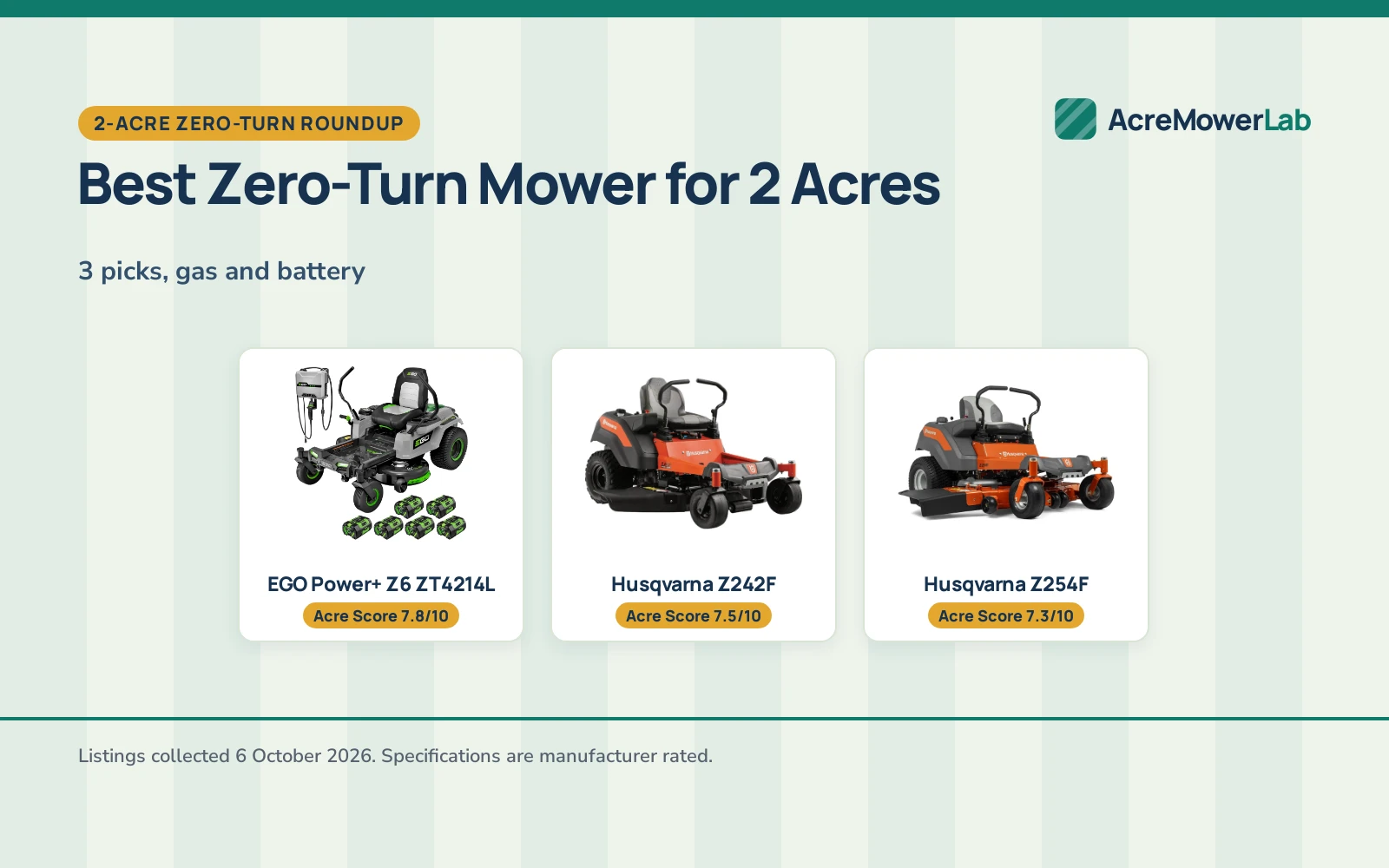
Our sizing guide details what size zero turn you need for your acreage, and our recommendations for the best zero turn mower for 2 acres highlight popular deck choices. Furthermore, specialized attachments like the Generic Z-Trimmer feature a 20-inch cutting width and require a minimum 15 Amp charging system to trim along fences while mowing.
Storing a wide zero-turn requires adequate outbuilding space. When keeping machinery protected from dust and moisture in covered or indoor storage, listings like Tough Cover provide fabric covers sized for mower decks up to 60 inches on machines without fixed ROPS bars. See our full review of the best riding mower cover options for seasonal protection.
Safety
Safe operation requires strict adherence to manufacturer guidelines, especially regarding terrain slope and machine handling. Never exceed the maker’s maximum slope rating stated in the operator manual. Zero-turn mowers lose traction readily on steep slopes, wet turf, and near ponds, ditches, or steep retaining walls. Always maintain a generous safety buffer from drop-offs and water hazards.
Where machines are equipped with a rollover protection structure (ROPS) and seat belt, always deploy the ROPS bar in the upright position and fasten the seat belt. Never carry passengers on a riding mower under any circumstances. Keep children, pets, and bystanders completely out of the yard while mowing. Always disengage mower blades and look behind you before shifting into reverse. Wear eye and hearing protection, along with sturdy footwear, to guard against thrown debris and engine noise. Always shut off the engine and allow hot exhaust components to cool completely before refueling. See our Safety Disclaimer.
FAQ: mowing large lots
Why are zero turn mowers faster than lawn tractors for large lawns?
Zero-turn mowers are faster on large lawns because they travel at higher cutting speeds and pivot within their own footprint. This eliminates multi-point turns at row ends and trims closely around trees and landscape borders, significantly reducing total mowing time.
Can a zero turn mower handle steep hills safely?
Zero-turn mowers struggle on steep slopes because they lack front-wheel steering and rely entirely on rear-wheel traction. On steep inclines or damp grass, rear wheels can slip, leading to loss of control. Always obey the manufacturer’s maximum slope rating and avoid mowing near ditches or pond banks.
Are zero turn mowers difficult to learn how to drive?
Operating independent steering levers feels unfamiliar to drivers accustomed to steering wheels. However, most operators master smooth starts, turns, and stops within brief practice sessions on flat, open ground before tackling obstacles.
Can you pull attachments with a zero turn mower?
Many zero-turn mowers can tow light yard equipment like broadcast spreaders, plug aerators, or utility dump carts when equipped with a proper hitch bracket. However, residential transaxles are not designed for heavy ground-engaging implements or excessive tongue weight, which can overheat hydraulic drive motors.
What size property justifies buying a zero turn mower?
Properties with extensive open turf or numerous obstacles benefit most from a zero-turn mower. While lawn tractors work well on smaller or steeply sloped parcels, property owners with expansive ground find the time savings well worth the investment.
More mowing guides
- How Fast Does a Zero Turn Mow?
- Are Zero Turn Mowers Safe on Hills?
- Can a Zero Turn Pull Attachments?
- Best Zero-Turn Mower for 2 Acres: 3 Picks by Deck Size
Compare options by acreage, terrain, and power type across our zero-turn mower reviews.