Are Flail Mowers Good for Brush Clearing?
A flail mower with hammer blades handles brush that a finish mower cannot, as long as the growth matches the blades and the ground is clear of hidden debris.

On this page
Top picks at a glance
As an Amazon Associate I earn from qualifying purchases.
- 1
 AMERISUN 22-Inch 170cc Walk Behind String Trimmer with9.4/10View on Amazon
- 2
 Earthquake Walk-Behind String Mower9.6/10View on Amazon
- 3
 Massey Ferguson 3606888M2 Mower Blades Set of 3 for 60 Inch9.6/10View on Amazon
At the edge of a field, brush takes hold fast: saplings push up through tall grass, brambles knit together along a fence line, and woody stems fill ground that a finish mower was never built to cut. The question landowners ask is simple: are flail mowers good for brush? Yes, with hammer blades fitted, a flail mower cuts woody stems and thick growth that a finish mower leaves behind, and it leaves the cut material mulched on the ground.
AcreMowerLab earns a commission when you shop through links here. It never changes your price. Affiliate disclosure.
Are flail mowers good for brush: what they cut well
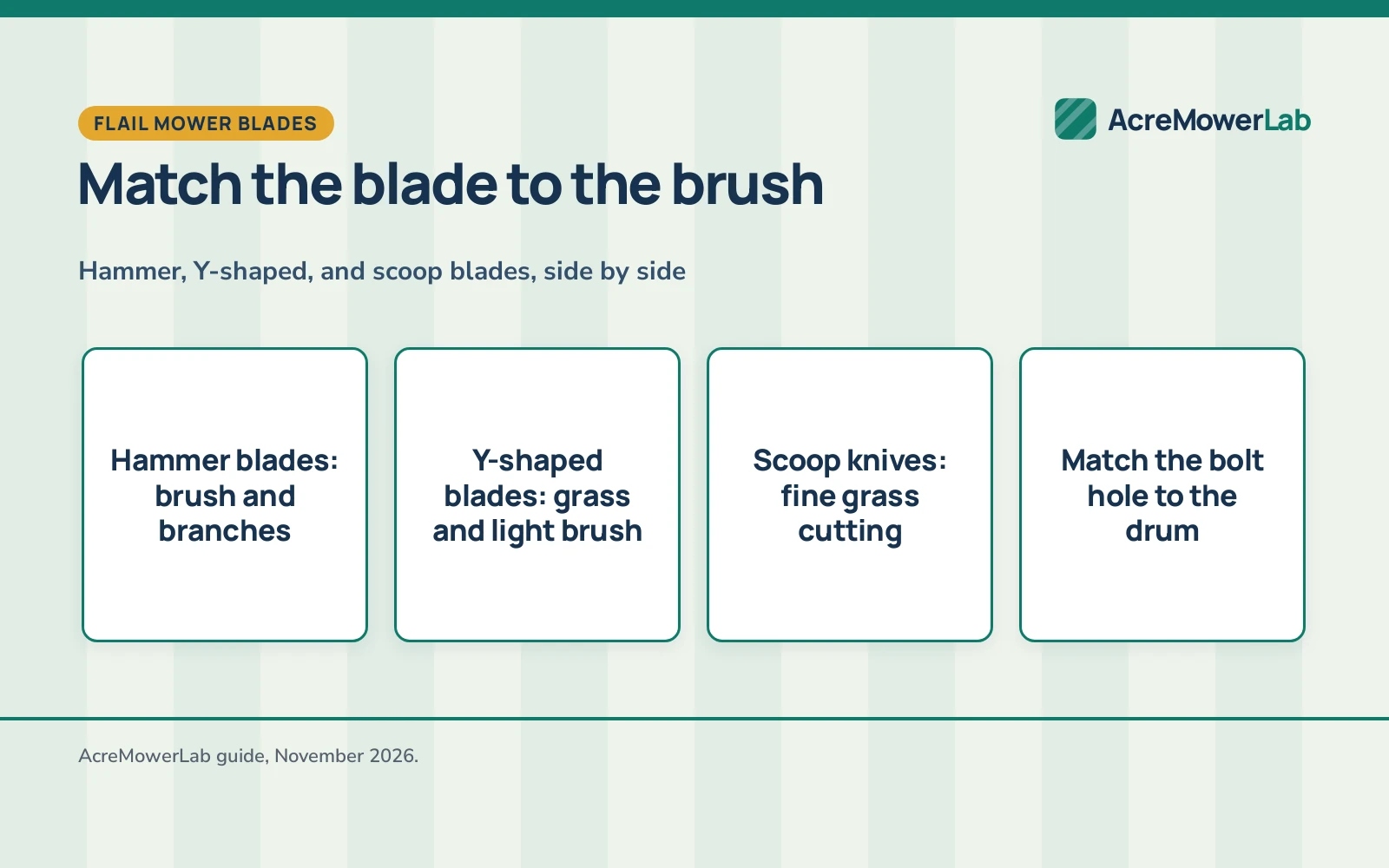
A flail mower suits brush because its blades swing free on a spinning drum and strike the growth instead of slicing it with a fixed edge. A blade that meets a woody stem hammers through it and shreds the cut pieces, which fall back onto the ground as mulch. Hammer blades do the heavy work here, while lighter blade shapes suit grass and weeds.
| Blade | Best for | Limit |
|---|---|---|
| Hammer blades | Woody stems, branches and thick brush | Needs the right fit for the drum |
| Y-shaped blades | Grass and light growth | Less bite on woody stems |
| Scoop knives | Fine grass, weeds and branches up to 1 inch in diameter | Medium duty rating |
Blade choice sets the result. See the flail mower blade types guide for the full comparison of shapes and fits.
How a flail mower cuts brush
The drum carries a row of blades, and each blade hangs from a bolt or pin so it can swing back when it strikes something hard. Hammer blades are the brush shape: a Threlaco hammer blade measures 4.3 inches in length and 3.5 inches in width, with a bolthole diameter of 0.6 inch, and the maker lists 40Cr forged steel as the material. A GIYI hammer blade measures 3.5 inches in length and 3.1 inches in width, with a 0.5 inch bolt hole diameter, and the maker lists 40Cr alloy steel with a galvanized surface finish.
Smaller blades suit lighter work. A Threlaco scoop knife measures 3.5 inches in length and 2.8 inches in width, and the maker states it can cut weeds and branches with a maximum diameter of 1 inch. A Vrisimo scoop knife measures 2.75 inches in width, 3.25 inches in height and 2.25 inches in depth, weighs 5.4 ounces, and is listed for medium duty work cutting weeds and branches up to 1 inch in diameter. A TF1019 blade measures 5-1/4 inches long by 1-3/4 inches wide and 0.145 inch thick, with a mounting hole that is a 1/2 inch by 1 inch slot.
What brush a flail mower handles
With hammer blades, a flail mower handles the growth that fills field edges and fence lines: tall grass, weeds, brambles, saplings and woody stems. The maker of the Threlaco hammer blades states the design can cut through branches, and the GIYI hammer blades are listed for tall grass, brush and fallen branches.
Ground conditions matter as much as the growth. Walk the area before mowing and clear wire, rope, stones and hidden metal, since a swinging blade that strikes a fixed object can chip or bend. For stems the mower cannot cut, hand clearing with a brush hook covers the gap; see how to use a brush hook to clear brush.
Where a flail mower falls short
A flail mower is not a clearing saw. Stems thicker than 1 inch in diameter sit outside the rating of the listed scoop knives, and the hammer blades state no diameter limit, so size the job to the blades fitted; forcing the mower through heavy stems wears blades fast and strains the drive. Wet ground makes the work harder: wet stems cut poorly, wet soil ruts under the wheels, and the mulched material clumps instead of spreading. On slopes, follow the mower manual maximum slope rating.
The finish is another limit. A flail mower leaves a mulched, rough-cut surface, not the smooth lawn finish of a rotary deck. That suits field edges, orchard rows and rough pasture, but not a front lawn. See brush mower vs lawn mower for the split between the two jobs.
Choose the right blades
Start with the blade shape. Hammer blades suit brush because of their weight and striking face, and the maker lists them for branches where Y-shaped blades fall short. The GIYI hammer blades can replace Y-shaped blades on the same drum, which suits an owner who wants to move from grass cutting to brush work without changing machines. Scoop knives suit fine grass cutting and weeds, and the listed scoop knives are rated for branches up to 1 inch in diameter; hammer blades are the shape the makers list for tall grass, brush and fallen branches.
Then check the fit. Blade width runs from 3 inches to 3.5 inches across the listed hammer blades, and the bolt hole runs from 0.4 inch to 0.6 inch, so measure the drum and the pins before ordering. Count the blades on the drum before ordering: a set of 25 blades can be a full set on one machine and a partial set on another, and the same TF1019 blade is sold singly and in packs of 10 and 20 to match.
Keep spare blades on hand
Blades wear, chip and bend on rough ground, so spares belong in the shed before the season starts. Listed packs run from 5 pieces to 100 pieces: a Threlaco 5-piece pack of 3 inch hammer blades weighs 5.13 pounds, a Threlaco 10-piece pack of 3 inch hammer blades weighs 9.26 pounds, and a Threlaco 10-piece pack of 3.5 inch hammer blades weighs 15.76 pounds. Vrisimo scoop knives come in a box of 50 weighing 17.0 pounds and a box of 100 weighing 34.0 pounds, and the maker notes that D-rings are not included with those boxes.
Keep the spares matched to the drum: same width, same bolt hole, same shape. A mixed set cuts unevenly and wears faster. See the best brush hog blades picks for replacement blades, and brush hog maintenance for blade care, gearbox checks and greasing.
Safety
Wear eye and hearing protection and sturdy shoes, and clear sticks, stones and other debris before mowing. Keep children, pets and bystanders away from the work area, since a flail mower can throw cut material and hidden objects. Never reach near the drum while the machine is running, and shut the machine down before clearing a jam or changing blades. Refuel only with the engine off and cool.
FAQ: mowing large lots
Are flail mowers good for brush on rough ground?
Yes. Rough ground with ruts, humps and tangled growth suits a flail mower, because the drum follows the ground and the swinging blades give way on impact.
Can a flail mower cut small trees?
It can cut saplings and woody stems. The listed scoop knives are rated for branches up to 1 inch in diameter, and larger trunks sit outside that rating and need a saw or hand tools instead. For stems the mower cannot cut, see how to use a brush hook to clear brush.
Which flail mower blades work best for brush?
Hammer blades work best for brush, because their weight and broad striking face cut woody stems, and the makers list them for branches where Y-shaped blades fall short. The listed hammer blades run 3 inches to 3.5 inches wide and use 40Cr steel. See the flail mower blade types guide for the full comparison.
How many spare flail mower blades to keep?
Count the blades on the drum first, then keep a full set plus spares for the blades that wear or chip. Listed packs run from 5 pieces to 100 pieces, so match the pack to the drum count.
Do flail mowers leave a clean finish on brush?
They leave a mulched, rough-cut finish rather than a smooth lawn finish. That suits field edges, orchard rows and rough pasture. For a neat lawn, a rotary deck is the right tool; see brush mower vs lawn mower.
More mowing guides
- Flail Mower Blade Types and How to Choose
- Brush Hog Maintenance: Blades, Gearbox and Greasing
- Brush Mower vs Lawn Mower: Which One Should You Buy?
- Best Brush Hog Blades (2026): 5 Replacement Picks
Browse the brush and field mowers category for more guides on clearing and maintaining rough ground.