Lawn Tractor Sizes
A practical guide to lawn tractor sizes: compare cutting deck widths, overall machine dimensions, storage clearances, and engine power for your acreage.

On this page
Top picks at a glance
As an Amazon Associate I earn from qualifying purchases.
- 1
 EGO Power+ Electric Riding Lawn Mower9.5/10View on Amazon
- 2
 Husqvarna TS 140X9.5/10View on Amazon
- 3
 Husqvarna TS 154X9.5/10View on Amazon
Managing open acreage with undulating terrain and thick turf requires equipment sized properly for the property. Lawn tractor sizes center on mower deck cutting width and overall physical dimensions. Standard residential lawn tractors feature cutting deck widths such as 46 inches and 54 inches. Stated specifications for Husqvarna models show machine lengths of 60 inches, heights of 50 inches, and operating widths from 54 inches to 60 inches. This guide breaks down dimensions, physical footprints, and clearance requirements step by step.
AcreMowerLab earns a commission when you shop through links here. It never changes your price. Affiliate disclosure.
Lawn tractor sizes: deck width and physical dimensions
| Model and deck size | Cutting width | Dimensions (L x W x H) | Engine and blades | Fuel capacity |
|---|---|---|---|---|
| Husqvarna TS 120 (46″) | 46 inches | 60″ x 54″ x 50″ | 22HP Briggs engine, 2 blades | 2.5 gallon |
| Husqvarna TS 140X (54″) | 54 inches | 60″ x 60″ x 50″ | 24HP Briggs engine, 3 blades | 3 gallon |
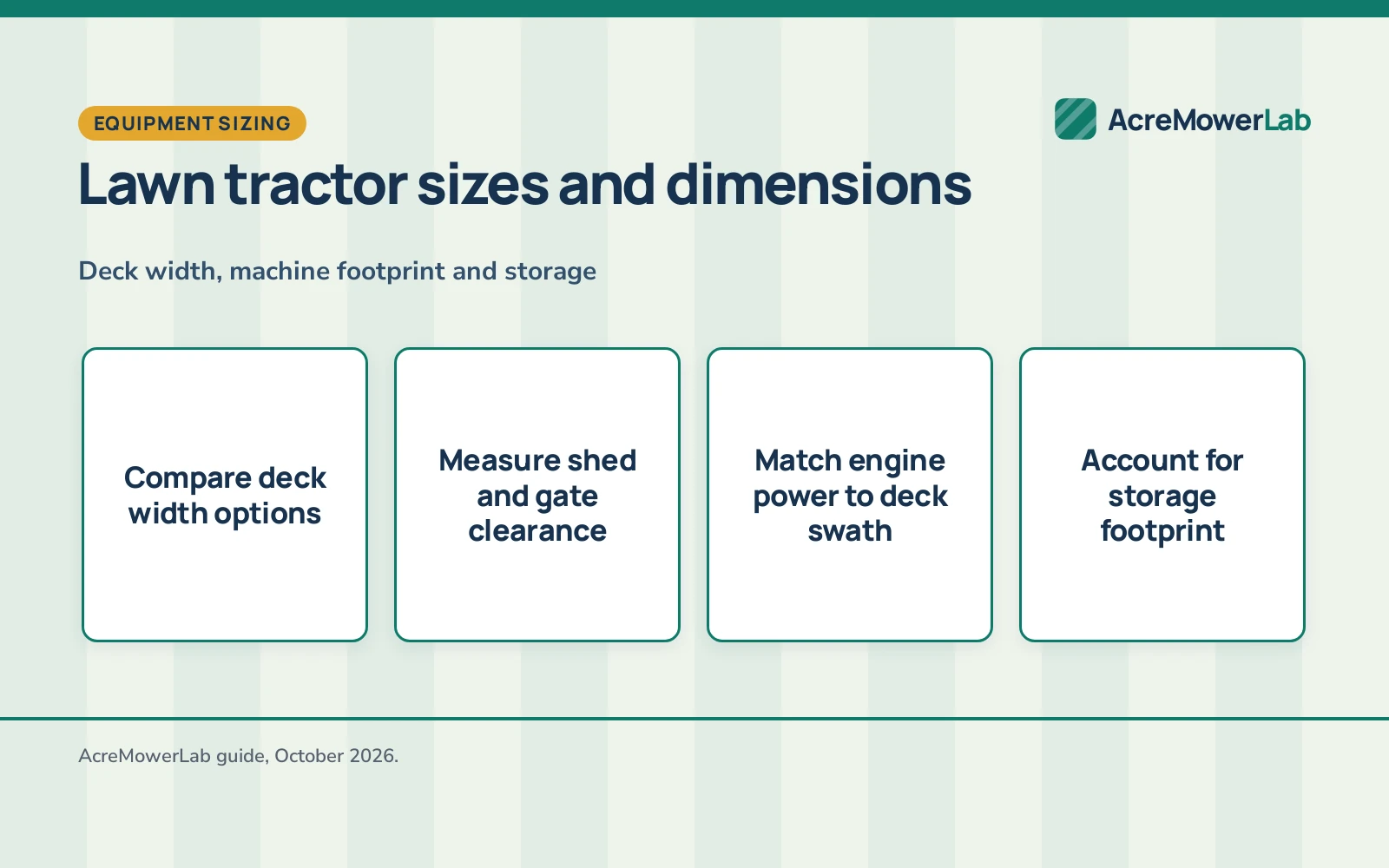
A lawn tractor cutting deck establishes swath per pass and storage clearance. Stated specifications from Husqvarna illustrate how deck widths and dimensions scale between models. Review our guide on what mower deck sizes mean to evaluate swath tradeoffs.
A wider cutting swath reduces total passes across open acreage, while a narrower deck clears tight passages. Overall exterior width exceeds nominal cutting swath because the deck shell and side discharge chute extend past blade tips.
Step 2: measure your storage space and gate openings
Before choosing a deck, measure every gate, shed door, and trailer opening. Nominal cutting width only measures the blade path. Total machine width includes the deck housing and side discharge chute.
For example, the Husqvarna TS 120 lists a 46-inch cutting width with a stated exterior width of 54 inches. The Husqvarna TS 140X lists a 54-inch cutting width with an exterior width of 60 inches. Consult our guide on what size riding mower do I need to verify access.
Both Husqvarna models share a 60-inch length and 50-inch height, establishing the baseline footprint before adding buffer clearance inside an enclosed trailer or utility shed.
Step 3: match engine power and blade count to the cutting swath
Engine horsepower scales with deck size because wider decks rotate more blades and clear more grass per pass. An undersized engine bogs down in thick turf, leaving ragged cuts.
Husqvarna equips the 46-inch TS 120 with a 2-blade stamped deck and a 22HP Briggs engine. The 54-inch TS 140X pairs a 3-blade stamped deck with a 24HP Briggs engine, maintaining blade tip speed through dense growth.
Both models use Tuff Torq hydrostatic transmissions for forward and reverse travel. Matching horsepower to deck size ensures reliable drive torque while blades maintain cutting speed. Read our comparison on lawn tractor vs riding mower differences.
Step 4: evaluate turning radius and ground obstacles
Yard obstacles determine how cleanly a tractor trims borders. A wider cutting deck extends farther past the tractor wheel track on the sides, allowing the deck to trim closer to fence lines and edging without tires rubbing against barriers.
However, that deck overhang requires wider pathways between orchard trees, raised beds, and outbuildings. Verify clearance with margin for steering adjustments. Our guide on riding lawn mower sizes details how deck overhang interacts with property layout.
On undulating ground, wider decks require extra clearance from surface rises to avoid contacting high spots during turns.
Step 5: check fuel capacity and rated ground speed
Mowing efficiency combines cutting swath with ground speed and fuel capacity. Husqvarna lists a 2.5 gallon fuel tank for the 22HP TS 120 and a 3 gallon capacity for the 24HP TS 140X.
Both models list a top forward ground speed of 5 mph and a reverse speed of 2 mph using Tuff Torq hydrostatic transmissions. While top speed serves for transport, actual mowing runs slower depending on turf conditions. The 54-inch deck covers more ground per pass than the 46-inch deck, and the 3 gallon tank extends runtime.
Always refuel outdoors on level ground with the engine switched off and completely cool before adding fuel or parking indoors.
Plan your storage footprint
A lawn tractor requires sheltered storage inside a garage, barn, or utility shed to protect belts, wiring, and seats from weather.
Account for the full machine footprint rather than nominal cutting width. A machine measuring 60 inches long, 50 inches high, and 54 inches to 60 inches wide needs surrounding clearance to check engine oil, clean deck chambers, and reach the battery.
Review our guide on how to store a riding mower for winter to prepare the fuel tank and electrical components for the off season.
Match deck size to grass density and terrain
Property topography influences deck performance. Wide decks excel on broad, level acreage where long continuous passes maximize efficiency. However, a wide rigid deck can scalp turf over hummocks and swales.
The shorter span of a 46-inch stamped deck follows rolling contours with less scalping risk than a 54-inch deck. For expansive acreage with uniform grade, the 54-inch deck delivers wide passes with fewer wheel tracks across the lawn.
Damp clippings reduce deck airflow and cutting performance. Consult our walkthrough on how to clean a mower deck to keep deck chambers clear.
Plan mowing passes across property zones
Structuring mowing passes reduces turning maneuvers across acreage. Divide ground into primary zones: open fields, fence lines, and building borders. Mow open areas first where long passes utilize full cutting width.
Save tight edging around beds for last. Near fence lines, aim the discharge chute away from posts and gravel driveways to prevent debris strikes. Overlapping passes slightly avoids leaving uncut strips between tire tracks.
Mind slope limits and ground conditions
Riding tractors have a higher center of gravity than walk-behind mowers, making them vulnerable to rollover on inclines.
Inspect manufacturer slope ratings in your manual before driving on hills. Mow up and down moderate slopes rather than across them when permitted, avoiding sudden turns or stops. Wet grass reduces tire traction, causing wheels to slide even on gentle grades.
Keep a safe standoff from ponds and drainage ditches where banks can collapse under tractor weight. If a slope feels uncertain, trim it with alternative equipment.
Safety
Operating a lawn tractor safely protects the operator, bystanders, and equipment across large properties. Observe the following core precautions during every mowing session:
- Follow manufacturer slope ratings strictly; never exceed stated incline limits.
- Keep children, pets, and bystanders clear of the mowing area before engaging blades.
- Disengage cutting blades completely before shifting into reverse or backing up.
- Wear sturdy work boots, safety glasses, and hearing protection during operation.
- Refuel only outdoors with the engine switched off and cool to the touch.
- Never carry passengers on the tractor or unapproved attachments.
- Stay well back from steep ditches, embankments, and water hazards.
- Verify operator presence controls and safety interlocks function before starting the engine.
FAQ: mowing large lots
What are standard lawn tractor sizes?
Standard residential lawn tractors center on cutting deck widths such as 46 inches and 54 inches. Husqvarna listings show machine lengths around 60 inches, heights around 50 inches, and widths from 54 inches to 60 inches including the deck.
How wide of a shed door is needed for a lawn tractor?
A storage door must accommodate the full deck assembly and deflector chute. The 46-inch Husqvarna TS 120 requires 54 inches of width clearance, while the 54-inch TS 140X requires 60 inches.
How fast does a lawn tractor mow?
Mowing speed depends on terrain and turf density. While Husqvarna lists a top forward ground speed of 5 mph and a reverse speed of 2 mph for transport, actual cutting runs slower to maintain cut quality.
Why do larger lawn tractor decks require more horsepower?
Wider cutting swaths and extra blades demand more engine output. Husqvarna equips the 46-inch, 2-blade deck with a 22HP engine, and the 54-inch, 3-blade deck with a 24HP engine to sustain blade tip speed.
Can a lawn tractor pull tow-behind yard attachments?
Yes, lawn tractors with a rear hitch can pull utility carts, sweepers, and aerators. Check your operator manual for towing capacity and tongue weight limits before hitching loads.
More mowing guides
- Riding Lawn Mower Sizes: Deck Width, Dimensions and Storage Guide
- What Size Riding Mower Do I Need?
- What Do Mower Deck Sizes Mean?
- Lawn Tractor vs Riding Mower: What Is the Difference?
Review our best riding lawn tractor guide to compare models, or explore our riding mowers hub for more acreage equipment recommendations.