Why Does My Riding Mower Leave Strips of Grass?
A troubleshooting guide for riding mower streaking, covering blade wear, deck pitch, tire pressure, ground speed and deck cleaning on large lawns.

On this page
Top picks at a glance
As an Amazon Associate I earn from qualifying purchases.
- 1
 Eparts Riding Mower Garden Tractor Seat9.4/10View on Amazon
- 2
 Greenworks 80V 42" CrossoverT Cordless Riding Lawn Tractor9.5/10View on Amazon
- 3
 Electric Riding Lawn Mower9.5/10View on Amazon
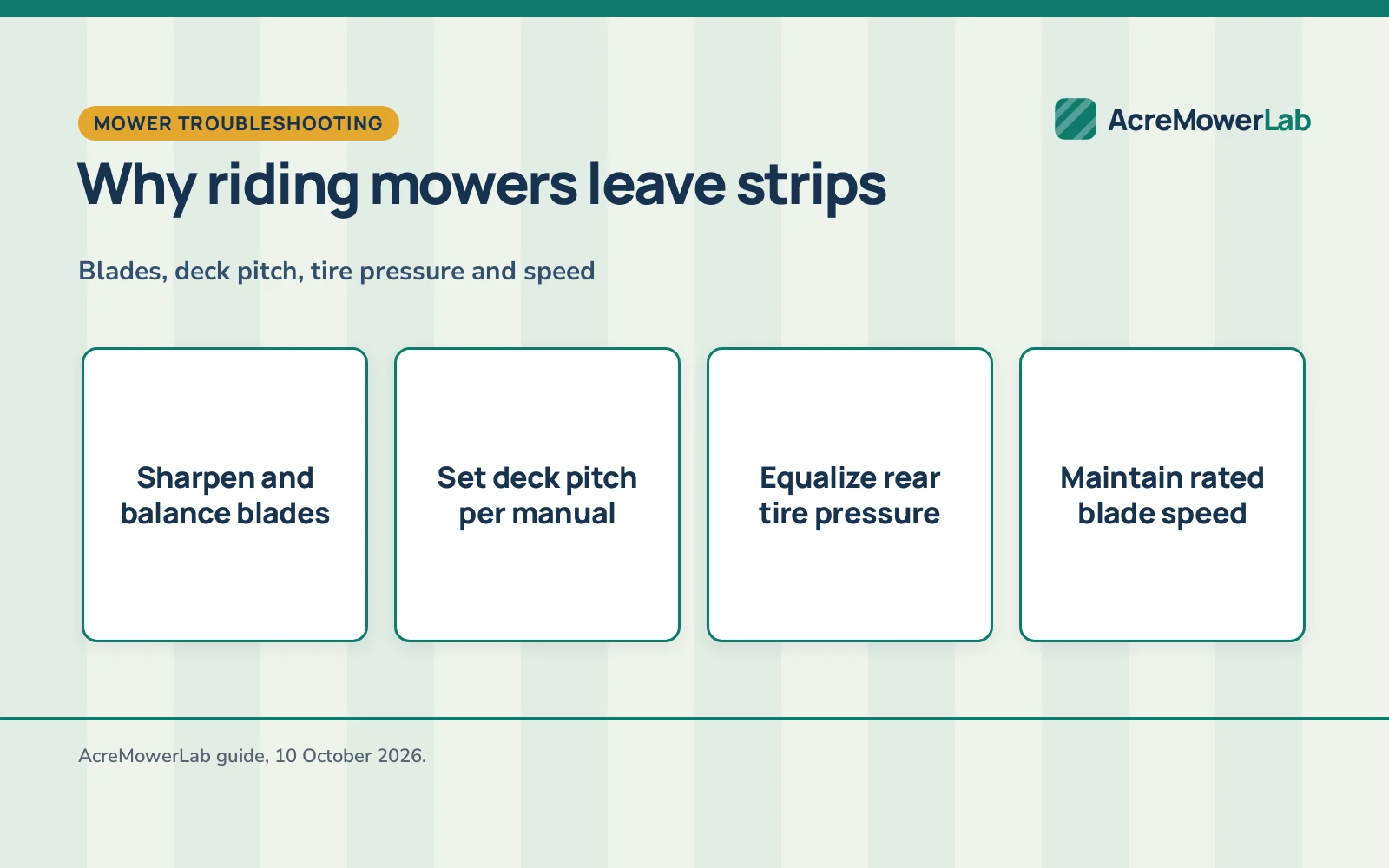
If you are asking why does my riding mower leave strips of grass, the cause is almost always dull or damaged blades, an unlevel mower deck, low engine throttle, uneven tire pressure, or packed clippings restricting airflow under the deck housing. A riding mower depends on strong deck suction to pull grass upright before cutting edges slice across each blade. When cutting edges wear round, travel speed outpaces blade tip speed, or the deck hangs unevenly, grass gets pressed flat under tires or deck baffles and fails to cut cleanly. Inspecting and adjusting these basic mechanical factors restores a level cut across your turf.
AcreMowerLab earns a commission when you shop through links here. It never changes your price. Affiliate disclosure.
Why does my riding mower leave strips of grass: primary causes and fixes
| Cause | Symptom | Quick fix |
|---|---|---|
| Dull or damaged blades | Frayed tips with ragged brown edges and standing strips | Sharpen or replace cutting blades |
| Improper deck level or pitch | Stepped cut pattern or ridges along the outer deck edge | Level deck side to side and adjust front pitch |
| Grass clipping buildup | Clumping wet debris and reduced airflow leaving streaks | Scrape clean underside of deck housing |
| Low blade speed or fast travel | Reduced suction fails to lift grass before blades pass | Maintain full blade speed and reduce travel speed |
| Uneven tire inflation | Deck hangs lower on one side causing an angled swath | Equalize tire pressure to manual specifications |
Identifying whether streaks appear between the blades, directly behind the tires, or along the outer deck edge helps pinpoint the mechanical source. If your machine cuts unevenly across the entire swath, see our guide on why zero-turn mowers cut unevenly for related deck geometry checks, or review our guide to the best riding mower for 1 acre if you are evaluating deck performance on typical acreage.
Step 2: inspect and sharpen mower blades
Mower blades are the primary factor in cut quality. When rotating at full operating speed, the curved sail on the back of each blade creates an upward vacuum that stands grass upright for a clean shear. Over time, striking soil and thatch rounds off the cutting edge and wears down lift wings. A dull blade tears grass rather than cutting it, leaving frayed tips and standing strips where stalks were bent aside.
Bent blades compound streaking because cutting tips no longer rotate on the same plane, leaving a ridge between blade circles. Inspect blades regularly for nicks and bends, and balance them after sharpening. Refer to our guide on how often you should sharpen mower blades for maintenance schedules, or examine specialized mulching blades for enhanced recutting performance. Always verify mounting orientation: an upside-down blade pushes air downward, flattening grass and leaving wide uncut streaks.
Step 3: level and pitch the mower deck
Mower decks hang from the chassis on adjustable linkages that can stretch or loosen over rough ground. Deck leveling requires checking side-to-side level and front-to-back pitch on flat concrete. Check side-to-side level by measuring from the outside blade tip to the ground on each side. If the deck hangs lower on one side, adjust the lift link until both blade tips measure equal distance from the pavement.
Next, check front-to-back pitch. Most manufacturers specify a slight forward rake, where the front blade tip sits slightly lower than the rear blade tip, though some manuals call for a level deck. If pitched backward with the front higher than the rear, blades recut grass along the rear arc of rotation, wasting power and leaving ragged streaks. If the front is pitched excessively low, the front deck shell presses grass flat before blades reach it, leaving uncut strips.
Step 4: clear clipping buildup under the deck
The underside of a mower deck relies on clean curves and baffles to channel airflow. When damp grass clippings accumulate, they form a crust that restricts the circular air current generated by spinning blades. Without sufficient airflow, grass remains bent over and escapes the cutting path. Packed debris also creates drag on blade spindles, slowing tip speed. Scraping the deck underside clean after damp mowing restores airflow dynamics. See our guide on how to clean a mower deck for cleaning procedures.
Step 5: balance tire pressure and overlap passes
Tire pressure directly dictates cutting deck orientation. Low pressure in a rear tire drops that corner of the machine, tilting the deck toward the soft tire and creating a stepped ridge. Check tire pressure with a gauge before adjusting deck linkages, ensuring that front and rear tires match manufacturer specifications.
Mowing overlap also affects streaking. When front tires roll across tall turf, they press grass stalks flat. If your mowing swath does not overlap the previous pass, flattened grass may not spring back up in time for the blade to cut it. Overlap each pass so the cutting deck covers the wheel tracks of the preceding pass, allowing blade lift to pull flattened grass upward.
Intentional lawn striping vs mowing streaks
Lawn striping is an aesthetic technique using a weighted roller behind the deck to bend grass blades in the direction of travel, creating light and dark visual patterns. Equipment listings publish specific figures across different designs. For example, John Deere lists a 40-pound weight and 54-inch deck compatibility for its LP1002 attachment. Grasshopper lists grooming kit weights of 5 pounds for its 48-inch deck and 6 pounds for its 52-inch deck, along with kits for its 61-inch V Series mid-mount decks.
In aftermarket zero-turn applications, Wyckoff lists striping kits for 50-inch, 54-inch, and 60-inch decks with a 26.38-inch total length. ATRACYPART publishes a 5.19-pound striping kit with a 12-month warranty for 50-inch, 54-inch, and 60-inch decks. On walk-behind equipment, EGO Power+ publishes a 14.3-pound weight for its 21-inch AR2100 kit, Suchtale lists kits fitting 18-inch and 20-inch widths with a 5.1-inch roller, and Zelvoro lists a 9-pound stainless steel kit for 21-inch equipment. In contrast to those deliberate aesthetic bands, mower streaking is an irregular defect caused by mechanical faults that leave uncut grass standing along the mowing line.
Match ground speed and throttle to grass density
Operating at reduced blade speed causes poor cut quality. On gas riding mowers, run the engine at full throttle while the deck is engaged to drive cooling airflow, maintain charging, and spin blades at rated tip speed. On battery riding mowers, select standard or high-speed mode rather than eco settings when cutting thick turf. Reduced tip speed diminishes aerodynamic lift, causing blades to push grass aside rather than slicing cleanly. Regulate travel speed entirely with drive controls. In thick or damp turf, slow forward speed so blades have time to process and discharge clippings cleanly without bogging down.
Plan mowing patterns across the property
Mowing in the same path repeatedly creates compacted wheel ruts. When tires drop into established ruts, the cutting deck tilts sideways, creating an uneven cut profile. Repeated passes in one direction also train grass blades to lean permanently away from deck suction. Alternate mowing patterns on every session, shifting between perpendicular and diagonal passes across the property to prevent soil compaction and rutting.
Check deck belt tension and spindle bearings
Drive belts stretch, glaze, and slip under heavy cutting loads. A slipping belt causes sudden drops in blade speed, leaving uncut strips where grass is densest. Inspect belts for cracks and check that the idler pulley spring maintains firm tension. Check spindle bearings by grasping blade tips while the machine is shut down; loose bearings cause blade wobble, vibration, and ragged streaks.
Safety
Practice strict safety when operating, inspecting, or servicing riding mowers. Never exceed the manufacturer’s maximum slope rating for your machine; zero-turn mowers and lawn tractors lose traction on steep slopes and near ponds, ditches, or embankments. Maintain clearance from drop-offs and water hazards. Always use the rollover protective structure and seat belt where equipped. Never carry passengers, and keep children, pets, and bystanders completely clear of the mowing area. Disengage cutting blades before reversing.
Wear eye protection, hearing protection, and sturdy footwear. Clear sticks, stones, wire, and debris before mowing. Refuel only with the engine off and cool. Before inspecting blades or the deck underside, shut down the engine, remove the key, set the parking brake, and disconnect the spark plug wire.
FAQ: mowing large lots
Why is my riding mower leaving a strip of uncut grass in the middle?
A center strip usually indicates clipping buildup on the center deck baffle, a slipping deck belt, or damaged blade lift wings collapsing the air channel between blade circles.
Can uneven tire pressure cause a riding mower to leave streaks?
Yes. Low air pressure in one rear tire drops that corner of the mower chassis, tilting the cutting deck and creating a visible ridge along pass edges.
Why does my mower leave streaks only when turning?
Sharp turns shift machine weight, compressing outside tires and tilting the deck. If ground speed is too high while turning, the deck pushes grass flat before blades can slice it.
How does forward speed affect mower streaking?
Driving too fast pushes grass flat under the deck shell faster than spinning blades can stand and cut it, leaving uncut streaks behind the wheels.
Will dull blades cause strips of grass to remain uncut?
Yes. Dull, rounded cutting edges lack slicing force, tearing rather than cutting grass and pushing flexible stalks aside.
More mowing guides
- Best Riding Mower for 1 Acre: 4 Picks by Deck Size
- How to Clean a Mower Deck
- How Often Should You Sharpen Mower Blades?
- Why Is My Zero Turn Cutting Uneven?
Consult our riding mower guides to compare machine types, deck configurations, and maintenance practices for your property.