Why Does My Riding Mower Scalp the Lawn?
A practical troubleshooting guide to riding mower lawn scalping: deck leveling, tire pressure balance, gauge wheel setup and mowing habits.

On this page
Top picks at a glance
As an Amazon Associate I earn from qualifying purchases.
- 1
 Eparts Riding Mower Garden Tractor Seat9.4/10View on Amazon
- 2
 Greenworks 80V 42" CrossoverT Cordless Riding Lawn Tractor9.5/10View on Amazon
- 3
 Electric Riding Lawn Mower9.5/10View on Amazon
- 4
 ANTHBOT M5 Robot Lawn Mower 1/8 AcreView on Amazon
- 5
 CRAFTSMAN 42" Gas Riding Lawn Mower with 17.5 HP* Briggs andView on Amazon
- 6
 BLACK+DECKER Electric Lawn MowerView on Amazon
- 7
 Inductive Hour Meter for Gas Engine Generator Lawn Mower RedView on Amazon
- 8
 Inductive Hour Meter for Engine Generator Lawn Mower 2PcsView on Amazon
- 9
 Inductive Hour Meter for Gas Engine Generator Lawn MowerView on Amazon
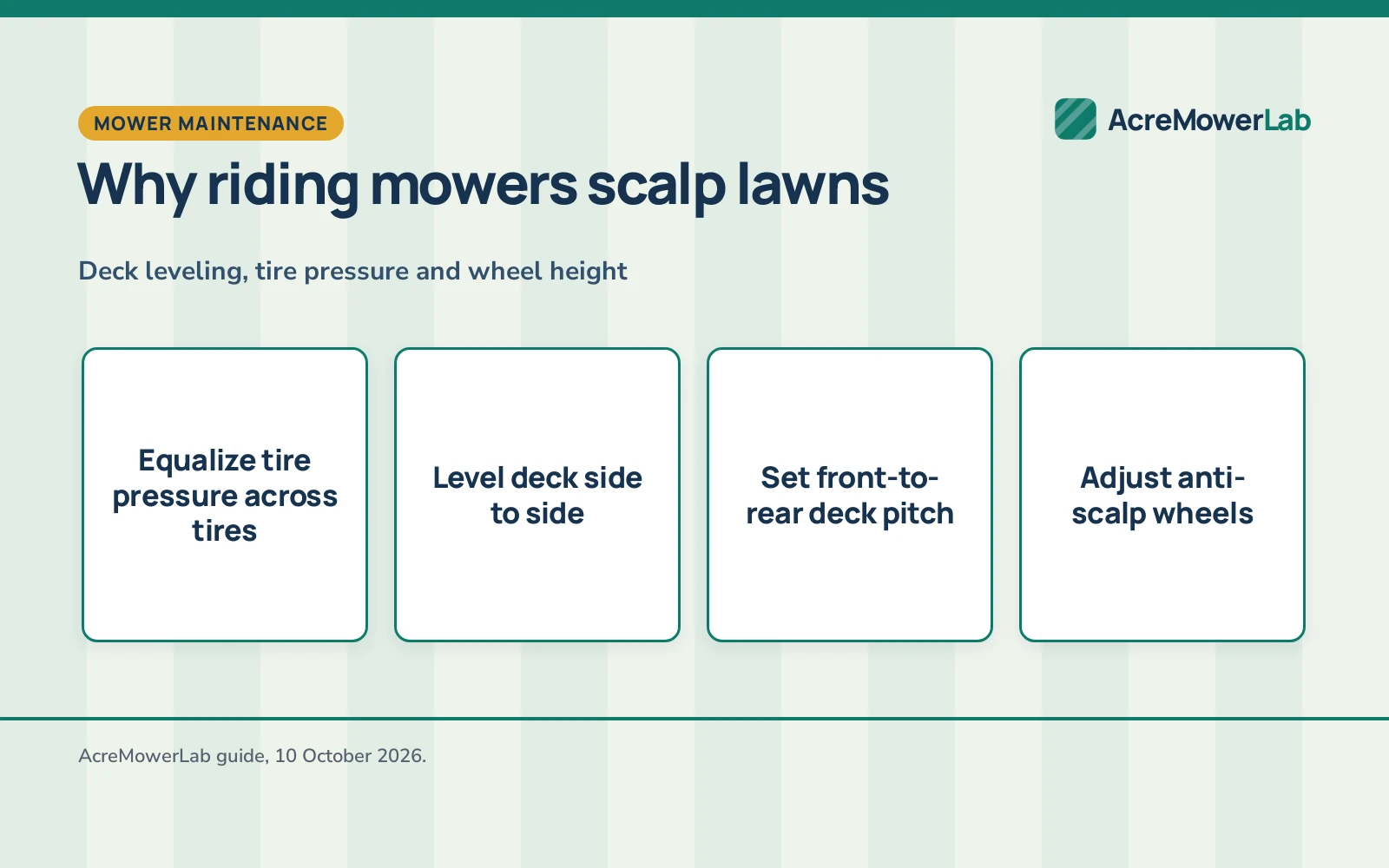
If you are wondering why does my riding mower scalp the lawn, the primary cause is an uneven cutting deck that drops too close to turf crowns, often due to mismatched tire pressure, misadjusted deck lift links, worn anti-scalp gauge wheels, or mowing too low over rolling turf. When a wide deck crosses high spots, the blades slice grass crowns down to the soil. Fixing mower scalping involves a logical progression: equalizing tire pressure across all tires, leveling the deck side to side, setting the proper front-to-rear deck pitch, and adjusting gauge wheels to float just above the ground.
Other machines to compare
 ANTHBOT M5 Robot Lawn Mower 1/8 AcreCheck price on Amazon
 CRAFTSMAN 42" Gas Riding Lawn Mower with 17.5 HP* Briggs andCheck price on Amazon
 BLACK+DECKER Electric Lawn MowerCheck price on Amazon
 Inductive Hour Meter for Gas Engine Generator Lawn Mower RedCheck price on Amazon
 Inductive Hour Meter for Engine Generator Lawn Mower 2PcsCheck price on Amazon
 Inductive Hour Meter for Gas Engine Generator Lawn MowerCheck price on Amazon
AcreMowerLab earns a commission when you shop through links here. It never changes your price. Affiliate disclosure.
Why does my riding mower scalp the lawn: core causes
| Cause | Symptom | Core Fix |
|---|---|---|
| Uneven tire pressure | Scalping along one side of the mowing stripe | Equalize tire pressure to the manufacturer manual specification |
| Unlevel mower deck | Consistent gouging on one side or at deck edges | Adjust deck lift links and pitch per operator manual |
| Missing or worn gauge wheels | Deck digs into crowns, ridges, and slopes | Install or replace anti-scalp deck wheels at proper height |
| Cutting height set too low | Widespread brown patches and bare turf crowns | Raise cutting height lever to leave adequate grass leaf |
| Mowing too fast over rough terrain | Bouncing deck gouges high spots and dips | Slow ground speed and smooth out deep ruts |
Addressing deck setup early protects both your turf and your mower spindles. If you are shopping for a machine with a more forgiving floating deck, see our guide to the best riding mower for 1 acre for models sized for residential acreage.
Step 2: equalize tire pressure
Before adjusting deck lift linkage, check the air pressure in all tires. Uneven tire inflation is a frequent cause of sudden mower deck tilt. Because a riding mower deck hangs from the machine frame, any difference in tire height tilts the entire cutting plane. Even a slight pressure drop in one rear tire lowers that corner, pulling the deck toward the turf and creating repeated scalped stripes.
Park on flat concrete before checking pressures. Inspect front and rear tires using an accurate pressure gauge, and inflate or deflate each tire until it matches the operating pressure specified in your operator manual. Rear drive tires support the bulk of machine weight, so keeping them balanced is critical. Recheck tire pressure regularly throughout the growing season.
Step 3: level the deck side to side
Once tires are inflated, inspect the side-to-side level of the cutting deck. A deck that hangs lower on one side will scalp high spots on that side while leaving the opposite side ragged. Park on flat, hard concrete, turn off the engine, remove the key, set the parking brake, and disconnect the spark plug wire before reaching near the blades.
Lower the mower deck to a mid-range cutting position. Rotate the outer cutting blades perpendicular to the machine frame, with blade tips pointing outward. Measure the vertical distance from the concrete floor to the cutting edge of each blade tip. If the measurements differ, loosen the lock nuts on the deck lift linkage hangers and adjust the leveling nuts until both blade tips sit at identical heights above the floor.
Step 4: set front-to-rear deck pitch
On most riding mowers, specifications call for forward deck pitch, where the front blade tip sits slightly lower than the rear blade tip. Proper pitch allows the front edge to cut grass cleanly once, while the rear edge sweeps freely over cut turf without dragging or recutting. Verify the recommended pitch in your machine manual, as some designs call for level alignment.
If the front of the deck sits higher than the rear, the blades cut at the back and the rear deck rim drags across mounds, causing severe scalping when tires climb an incline. Rotate a blade parallel to the frame, measure the distance from the floor to the front and rear blade tips, and adjust the deck pitch linkage or draft rods to achieve the specified pitch.
Step 5: inspect and adjust anti-scalp gauge wheels
Anti-scalp gauge wheels prevent the deck shell from striking the ground when rolling across high spots, swales, or ridges. On floating suspended decks, anti-scalp gauge wheels are designed not to carry deck weight during normal mowing on level turf. Unless your manual specifies a ground-contact roller deck, gauge wheels should hover slightly above flat ground.
When gauge wheels constantly roll on the lawn, they wear out prematurely, tear turf during turns, and hinder the floating suspension. Park on flat concrete with the deck at your chosen cutting height. Adjust the gauge wheel mounting shoulder bolts into the bracket holes that keep the wheels hovering just above the surface, ready to roll only on high spots.
Anti-scalp wheel sizing and replacement
When gauge wheels wear down, crack, or break off, the steel deck edge can gouge directly into soil. Selecting replacement wheels requires matching the deck size, bore diameter, and wheel dimensions specified for your mower deck.
For example, CheeMuii lists 5-inch replacement deck gauge wheels with a 2-3/4-inch width and 1/2-inch center hole for compatible 42-inch, 46-inch, 48-inch, 50-inch, 52-inch, and 54-inch decks. In separate replacement listings, CheeMuii also offers heavy-duty 5-inch wheels with a 5/8-inch bore and 2.67-inch height in 2, 4, 6, and 8 packs for select compatible zero-turn and tractor decks. Fourtry lists rear deck roller wheels sized at 4-3/4 inches by 1-3/8 inches with a 1/2-inch bore for compatible 42-inch and 46-inch decks. Similarly, DEHOMKUS lists 5-inch deck gauge wheels with a 2-3/8-inch width and 1/2-inch bore for compatible 42-inch, 50-inch, and 54-inch decks. Replacing worn wheels restores proper clearance and prevents deck gouging.
Adjust cutting height for uneven ground
Cutting height basics play a critical role in preventing lawn scalping. Setting the deck lever too low guarantees scalping on rolling ground. When a wide riding mower deck spans across a mound or ridge, the high spot rises above tire level, slicing into turf crowns.
Raise the cutting deck lever to a setting that leaves sufficient green leaf canopy. Taller grass cushions the ground and hides minor terrain inconsistencies. On lawns with dips and ridges, cutting higher prevents deck corners from digging in when tires drop into ruts. For seasonal adjustments, see our advice on riding mower deck settings across grass varieties.
Mowing patterns and ground speed
Your mowing technique directly influences cut quality. At excessive ground speed, the tractor and suspended deck bounce over uneven ground. When the deck rebounds downward on its lift linkages, the blades plunge into high spots, leaving deep scalp marks. Slow down over rough terrain, ditches, and slopes so the deck floats smoothly.
Vary your mowing pattern each session. Following the same wheel tracks compresses soil and creates tire ruts that drop the deck closer to the surface. Alternating mowing direction diagonally or perpendicular prevents rutting. For related issues, consult our guide on why does my riding mower leave strips of grass to resolve uneven clipping patterns.
Inspect blades, spindles, and deck hardware
Damage under the deck can mimic or worsen scalping. A bent mower blade rotates with an uneven cutting plane, cutting lower than intended across its path and leaving a distinct scalp stripe. Strike damage from rocks, roots, or debris can bend a blade tip downward.
Inspect cutting blades regularly. Disconnect the spark plug, raise the deck, and check blades for straightness and wear. See our guide on how often to sharpen mower blades to maintain clean cutting edges. Check blade spindles for bearing play by checking for vertical movement with gloved hands. Worn spindle bearings allow the blade assembly to wobble under load, causing sudden scalp marks. Our review of essential lawn tractor parts highlights common deck replacement components.
Safety
Working around a riding mower cutting deck requires strict adherence to safety protocols. Always disengage cutting blades, shut off the engine, remove the key, set the parking brake, and disconnect the spark plug wire before reaching under the deck to measure blade heights or replace gauge wheels. Wear work gloves, eye protection, and hearing protection during maintenance and mowing. Clear the yard of sticks, rocks, wire, and debris before mowing.
Operate riding mowers and zero-turn machines with caution on grades. Never exceed the maker’s max slope rating listed in your operator manual. Zero-turns can lose traction on slopes and near ponds or ditches, creating rollover hazards. Keep the rollover protective structure (ROPS) locked upright and fasten your seat belt where equipped. Never carry passengers, and keep children and pets completely out of the yard while mowing. Turn blades off when reversing. When refueling, always turn the engine off and allow it to cool completely before adding fuel. See our Safety Disclaimer.
FAQ: mowing large lots
Why does my riding mower scalp on uneven ground?
A wide cutting deck cannot flex with terrain contours. When tires roll into depressions or straddle ridges, the rigid deck shell or blade tips gouge the highest point of the ground.
Should anti-scalp wheels touch the ground?
No. Anti-scalp gauge wheels should hover slightly above the surface on flat ground at your cutting height, contacting the turf only momentarily when crossing mounds.
How often should I level my mower deck?
Check deck level at the start of each spring mowing season, after hitting a solid obstacle such as a tree root, or whenever you notice an uneven cut or scalping along one side.
Will scalped grass grow back?
Most established turfgrasses recover from scalping if the crown remains undamaged. Provide adequate water, avoid foot traffic, and raise cutting height on subsequent passes until the canopy recovers.
Why is my mower scalping only on one side?
Scalping on only one side is typically caused by low pressure in one rear tire, an unlevel deck lift linkage, or a bent blade on that side of the machine.
More mowing guides
- Why Does My Riding Mower Leave Strips of Grass?
- Why Is My Zero Turn Cutting Uneven?
- Best Riding Mower for 1 Acre: 4 Picks by Deck Size
- Lawn Tractor Parts: Maintenance and Replacement Guide
Use the Mower Matcher to narrow down choices by acreage, terrain, budget, and power type.